@dannote/figma-use
v0.8.0
Control Figma from the command line. Full read/write access for AI agents.
32/weekUpdated 2 weeks agoMITUnpacked: 13.3 MB
Published by Danila Poyarkov
npm install @dannote/figma-usefigma-use
CLI for Figma. Control it from the terminal — with commands or JSX.
``bashCreate and style
figma-use create frame --width 400 --height 300 --fill "#FFF" --layout VERTICAL --gap 16
figma-use create icon mdi:home --size 32 --color "#3B82F6"
figma-use set fill 1:23 "$Colors/Primary"
Or render JSX
echo '
' | figma-use render --stdin --x 100 --y 100
`
Why
Figma's official MCP plugin can read files but can't modify them. This one can.
LLMs know CLI. LLMs know React. This combines both.
CLI commands are compact — easy to read, easy to generate, easy to chain. When a task involves dozens of operations, every saved token matters. MCP and JSON-RPC work too, but they add overhead.
JSX is how LLMs already think about UI. They've seen millions of React components. Describing a Figma layout as
is natural for them — no special training, no verbose schemas.Demo
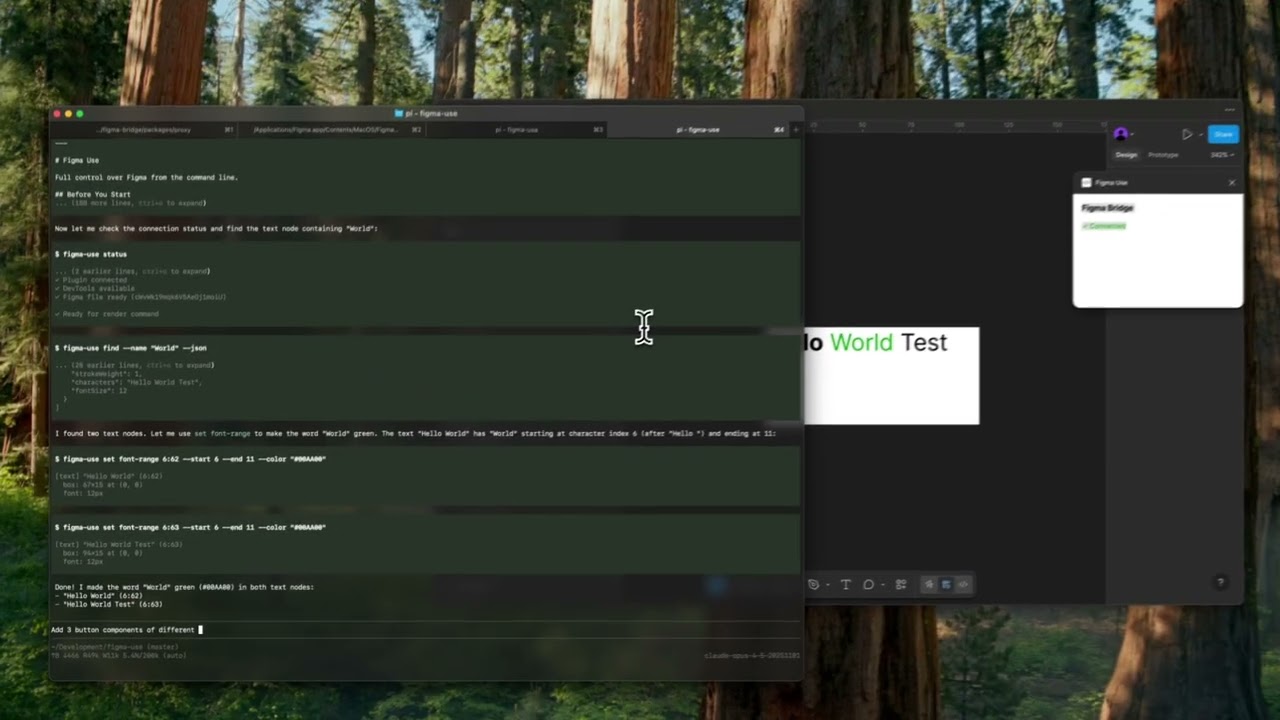
▶️ Button components
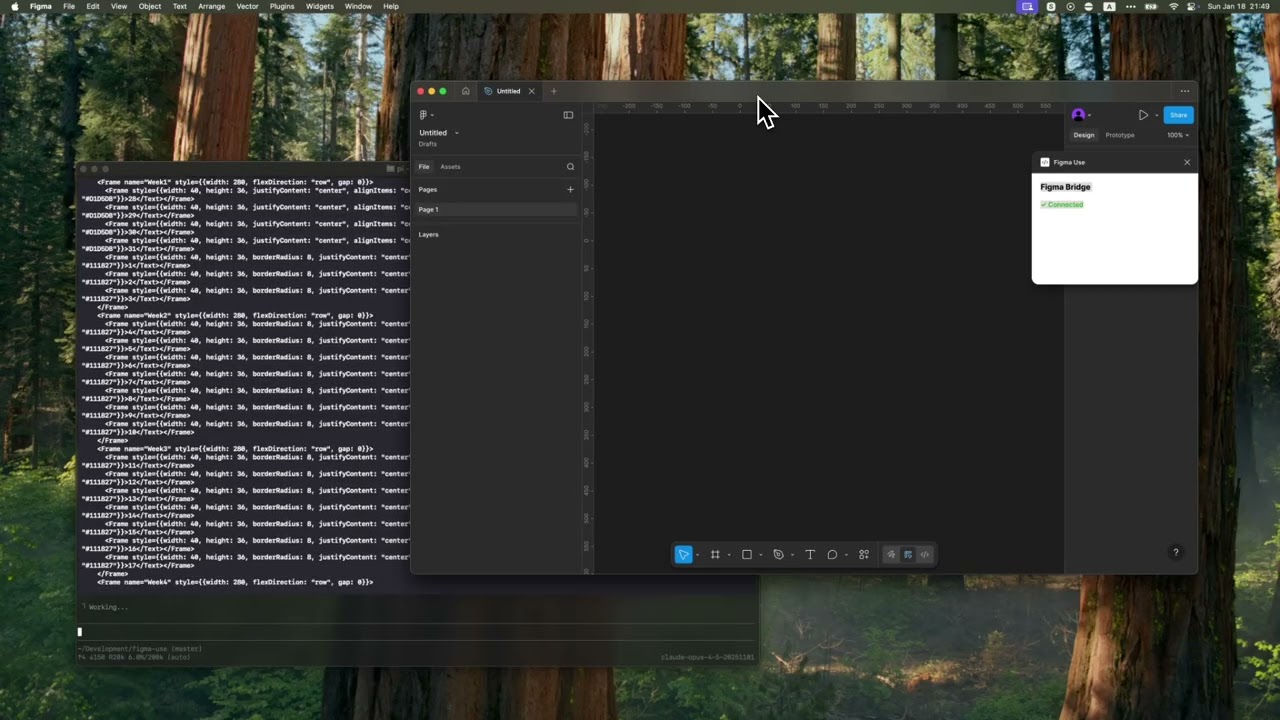
▶️ Tailwind UI calendar
Installation
`bash
npm install -g @dannote/figma-usefigma-use plugin install # Quit Figma first
figma-use proxy # Start proxy server
`Open Figma → Plugins → Development → Figma Use
Two Modes
Imperative — one command at a time:
bash
figma-use create frame --width 400 --height 300 --fill "#FFF" --radius 12 --layout VERTICAL --gap 16
`Or declaratively — describe the structure in JSX and render it:
bash
echo '
  Card Title
  Description
' | figma-use render --stdin --x 100 --y 200
`The stdin mode accepts pure JSX only — no variables, no logic. For components, variants, and conditions, use
files.Examples
$3
Insert any icon from Iconify by name. No downloading, no importing, no cleanup.
`bash
figma-use create icon mdi:home
figma-use create icon lucide:star --size 48 --color "#F59E0B"
`In JSX:
tsx
`Browse 150k+ icons: icon-sets.iconify.design
$3
In a
file you can define components. First call creates the master, the rest create instances:`tsx
import { defineComponent, Frame, Text } from '@dannote/figma-use/render'const Card = defineComponent(
'Card',
Card
)
export default () => (
)
`$3
ComponentSet with all combinations:
tsx
import { defineComponentSet, Frame, Text } from '@dannote/figma-use/render'const Button = defineComponentSet(
'Button',
{
variant: ['Primary', 'Secondary'] as const,
size: ['Small', 'Large'] as const,
},
({ variant, size }) => (
p: size === 'Large' ? 16 : 8,
bg: variant === 'Primary' ? '#3B82F6' : '#E5E7EB',
rounded: 8,
}}
>
{variant} {size}
)
)
export default () => (
)
`This creates a real ComponentSet in Figma with all 4 variants, not just 4 separate buttons.
$3
Bind colors to Figma variables by name. The hex value is a fallback:
tsx
import { defineVars, Frame, Text } from '@dannote/figma-use/render'const colors = defineVars({
bg: { name: 'Colors/Gray/50', value: '#F8FAFC' },
text: { name: 'Colors/Gray/900', value: '#0F172A' },
})
export default () => (
Bound to variables
)
`In CLI, use
or $Colors/Primary in any color option.$3
Compare two frames and get a patch:
`bash
figma-use diff create --from 123:456 --to 789:012
`diff
--- /Card/Header #123:457
+++ /Card/Header #789:013
@@ -1,5 +1,5 @@
type: FRAME
size: 200 50
pos: 0 0
-fill: #FFFFFF
+fill: #F0F0F0
-opacity: 0.8
+opacity: 1
`Apply the patch to the original frame. On apply, current state is validated against expected — if they don't match, it fails.
Visual diff highlights changed pixels in red:
bash
figma-use diff visual --from 49:275096 --to 49:280802 --output diff.png
`| Before | After | Diff |
|--------|-------|------|
| !before | !after | !diff |
$3
Page tree in readable form:
$ figma-use node tree
[0] frame "Card" (1:23)
    400×300 at (0, 0) | fill: #FFFFFF | layout: col gap=16
  [0] text "Title" (1:24)
      "Hello World" | 24px Inter Bold
Export any node or screenshot with one command.
$3
Import SVG or work with paths directly — read, modify, translate, scale, flip:
bash
figma-use path get
figma-use path set  "M 0 0 L 100 100 Z"
figma-use path scale  --factor 1.5
figma-use path flip  --axis x
`$3
Find nodes using XPath selectors:
bash
figma-use query "//FRAME"                              # All frames
figma-use query "//FRAME[@width < 300]"                # Narrower than 300px
figma-use query "//COMPONENT[starts-with(@name, 'Button')]"  # Name starts with
figma-use query "//FRAME[contains(@name, 'Card')]"     # Name contains
figma-use query "//SECTION/FRAME"                      # Direct children
figma-use query "//SECTION//TEXT"                      # All descendants
figma-use query "//*[@cornerRadius > 0]"               # Any node with radius
`Full XPath 3.1 support — predicates, functions, arithmetic, axes.
Render via Multiplayer Protocol
The
command uses Figma's internal multiplayer protocol, not just Plugin API. It's faster, but the protocol is internal and may change. Good for generation and prototyping.Full Command Reference
See REFERENCE.md for the complete list of 100+ commands.
For AI Agents
Includes SKILL.md — a reference for Claude Code, Cursor, and other agents.
`bash
mkdir -p ~/.claude/skills/figma-use
curl -o ~/.claude/skills/figma-use/SKILL.md \
https://raw.githubusercontent.com/dannote/figma-use/master/SKILL.md
`MCP Server
The proxy exposes an MCP endpoint at
with 90+ tools. Run figma-use mcp for config.See MCP.md for full documentation.
How It Works
`
┌─────────────┐     ┌─────────────┐     ┌─────────────┐
│   Terminal  │────▶│  figma-use  │────▶│   Plugin    │
│             │ CLI │    proxy    │ WS  │             │
└─────────────┘     └──────┬──────┘     └─────────────┘
                           │
                    MCP ───┤ WebSocket (multiplayer)
                           ▼
                    ┌─────────────┐
                    │   Figma     │
                    └─────────────┘
License
MIT