@mindblowing/snapdom
v1.9.9TypeScript
snapDOM captures HTML elements to images with exceptional speed and accuracy.
zumerlabsnapDOMscreenshotenginehtml capturedom capturehtml to imagedom to imagehtml screenshotcapture element
0/weekUpdated 6 months agoMITUnpacked: 187.1 KB
Published by Juan Martin Muda
npm install @mindblowing/snapdomsnapDOM
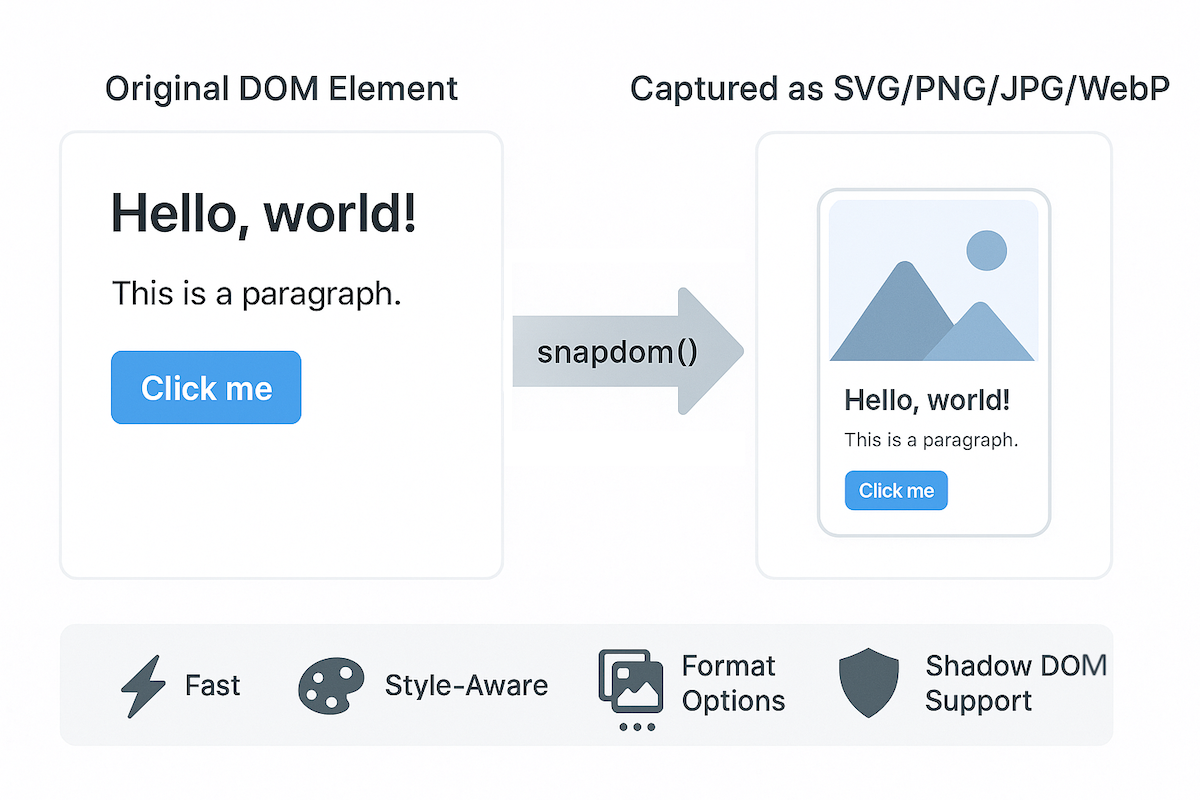




snapDOM is a fast and accurate DOM-to-image capture tool built for Zumly, a zoom-based view transition framework.
It captures any HTML element as a scalable SVG image, preserving styles, fonts, background images, pseudo-elements, and even shadow DOM. It also supports export to raster image formats and canvas.
* 📸 Full DOM capture
* 🎨 Embedded styles, pseudo-elements, and fonts
* 🖼️ Export to SVG, PNG, JPG, WebP, or canvas
* ⚡ Ultra fast, no dependencies
* 📦 100% based on standard Web APIs
Demo
https://zumerlab.github.io/snapdom/
Installation
$3
``sh`
npm i @zumer/snapdom
`sh`
yarn add @zumer/snapdom
$3
`html`
$3
`html`
$3
`js`
import { snapdom } from './snapdom.mjs';
$3
`html`
Basic usage
$3
`js
const el = document.querySelector('#target');
const result = await snapdom(el, { scale: 2 });
const img = await result.toPng();
document.body.appendChild(img);
await result.download({ format: 'jpg', filename: 'my-capture' });
`
$3
`js
const el = document.querySelector('#target');
const png = await snapdom.toPng(el);
document.body.appendChild(png);
const blob = await snapdom.toBlob(el);
`
API
$3
Returns an object with reusable export methods:
`js`
{
url: string;
toRaw(): string;
toImg(): Promise
toCanvas(): Promise
toBlob(): Promise
toPng(): Promise
toJpg(options?): Promise
toWebp(options?): Promise
download(options?): Promise
}
$3
| Method | Description |
| ------------------------------ | ------------------------------------- |
| snapdom.toImg(el, options?) | Returns an HTMLImageElement |snapdom.toCanvas(el, options?)
| | Returns a Canvas |snapdom.toBlob(el, options?)
| | Returns an SVG Blob |snapdom.toPng(el, options?)
| | Returns a PNG image |snapdom.toJpg(el, options?)
| | Returns a JPG image |snapdom.toWebp(el, options?)
| | Returns a WebP image |snapdom.download(el, options?)
| | Triggers download in specified format |
Options
All capture methods accept an options object:
| Option | Type | Default | Description |
| ----------------- | -------- | -------- | ------------------------------------------ |
| compress | boolean | true | Removes redundant styles |fast
| | boolean | true | Skips idle delay for faster results |embedFonts
| | boolean | false | Inlines fonts (icon fonts always embedded) |scale
| | number | 1 | Output scale multiplier |width
| | number | - | Output specific width size |height
| | number | - | Output specific height size |backgroundColor
| | string | "#fff" | Fallback color for JPG/WebP |quality
| | number | 1 | Quality for JPG/WebP (0 to 1) |useProxy
| | string | '' | Specify a proxy for handling CORS images as fallback|type
| | string | svg | Select png, jpg, webp Blob type|exclude
| | string[] | - | CSS selectors for elements to exclude |filter
| | function | - | Custom filter function ie (el) => !el.classList.contains('hidden') |
$3
Use the width and height options to generate an image with specific dimensions.
Examples:
1. Fixed width (proportional height)
Sets a specific width while maintaining the aspect ratio. Height adjusts proportionally.
`js`
const result = await snapdom(element, {
width: 400 // Outputs a 400px-wide image with auto-scaled height
});
2. Fixed height (proportional width)
Sets a specific height while maintaining the aspect ratio. Width adjusts proportionally.
`js`
const result = await snapdom(element, {
height: 200 // Outputs a 200px-tall image with auto-scaled width
});
3. Fixed width and height (may distort image)
Forces exact dimensions, potentially distorting the image if the aspect ratio differs.
`js`
const result = await snapdom(element, {
width: 800, // Outputs an 800px × 200px image (may stretch/squish content)
height: 200
});
Note: If scale is different from 1, it takes priority over width and height.{ scale: 3, width: 500 }
Example: ignores width and scales the image 3x instead.
$3
By default, snapDOM loads images with crossOrigin="anonymous" or crossOrigin="use-credentials". In case fails to get the images, useProxy can be used to deal with CORS images:
`js`
const result = await snapdom(element, {
useProxy: 'your/proxy/' //Example: 'https://corsproxy.io/?url=' or 'https://api.allorigins.win/raw?url='
});
$3
`js`
{
format?: "svg" | "png" | "jpg" | "jpeg" | "webp"; // default: "png"
filename?: string; // default: "capture"
backgroundColor?: string; // optional override
}
$3
The preCache() function can be used to load external resources (like images and fonts) in advance. It is specially useful when the element to capure is big and complex.
`js
import { preCache } from '@zumer/snapdom';
await preCache(document.body);
`
`js`
import { snapdom, preCache } from './snapdom.mjs';
window.addEventListener('load', async () => {
await preCache();
console.log('📦 Resources preloaded');
});
Options for preCache():
embedFonts (boolean, default: true)* — Inlines non-icon fonts during preload.
reset (boolean, default: false)* — Clears all existing internal caches.
useProxy (string)* — Proxy for handling CORS images as fallback.
Features
* Captures shadow DOM and Web Components
* Supports ::before, ::after and ::first-letter pseudo-elementsdata-capture="exclude"
* Inlines background images and fonts
* Handles Font Awesome, Material Icons, and more
* to ignore an elementdata-capture="placeholder"
* with data-placeholder-text for masked replacements
Limitations
* External images shloud be CORS-accessible (use useProxy option for handling CORS denied)@font-face
* Iframes are not supported
* When WebP format is used on Safari, it will fallback to PNG rendering.
* CSS rule is well supported, but if need to use JS FontFace(), see this workaround #43
⚡ Performance Benchmarks
Snapdom has received significant performance improvements since version v1.8.0. The following benchmarks compare:
* Snapdom (current)
* Snapdom v1.8.0
* html2canvas
*
$3
| Scenario | Snapdom (current) | Snapdom v1.8.0 | html2canvas | html-to-image |
| ------------------------ | ----------------- | -------------- | ----------- | ------------- |
| Small (200×100) | 0.4 ms | 1.2 ms | 70.3 ms | 3.6 ms |
| Modal (400×300) | 0.4 ms | 1.1 ms | 68.8 ms | 3.6 ms |
| Page View (1200×800) | 0.4 ms | 1.0 ms | 100.5 ms | 3.4 ms |
| Large Scroll (2000×1500) | 0.4 ms | 1.0 ms | 153.1 ms | 3.4 ms |
| Very Large (4000×2000) | 0.4 ms | 1.0 ms | 278.9 ms | 4.3 ms |
$3
| Scenario | Snapdom (current) | Snapdom v1.8.0 | html2canvas | html-to-image |
| ------------------------ | ----------------- | -------------- | ----------- | ------------- |
| Small (200×100) | 1.1 ms | 3.2 ms | 76.0 ms | 15.3 ms |
| Modal (400×300) | 4.5 ms | 14.0 ms | 133.2 ms | 55.4 ms |
| Page View (1200×800) | 32.9 ms | 113.6 ms | 303.4 ms | 369.1 ms |
| Large Scroll (2000×1500) | 133.9 ms | 387.4 ms | 594.4 ms | 1,163.0 ms |
| Very Large (4000×2000) | 364.0 ms | 1,200.4 ms | 1,380.8 ms | 3,023.9 ms |
$3
* Snapdom (current) is 2×–6× faster than v1.8.0
* Up to 150× faster than
* Up to 8× faster than in large scenarios
Benchmarks run in Chromium using Vitest.
Hardware: MacBook Air 2018.
⚠️ Performance may vary depending on device.
$3
`sh`
git clone https://github.com/zumerlab/snapdom.git
cd snapdom
npm install
npm run test:benchmark
Development
To contribute or build snapDOM locally:
`shClone the repository
git clone https://github.com/zumerlab/snapdom.git
cd snapdom
Switch to dev branch
git checkout dev
Install dependencies
npm install
Compile the library (ESM, CJS, and minified versions)
npm run compile
Install playwright browsers (necessary for running tests)
npx playwright install
Run tests
npm test
Run Benchmarks
npm run test:benchmark
`
The main entry point is in
, and output bundles are generated in the dist/` folder.For detailed contribution guidelines, please see CONTRIBUTING.
Contributors 🙌


💖 Sponsors
Special thanks to @megaphonecolin for supporting this project!
If you'd like to support this project too, you can become a sponsor.
License
MIT © Zumerlab