@modelcontextprotocol/server-budget-allocator
v1.0.1TypeScript
Budget allocator MCP App Server with interactive visualization
0/weekUpdated 2 days agoMITUnpacked: 3.4 MB
Published by jspahrsummers
npm install @modelcontextprotocol/server-budget-allocatorExample: Budget Allocator App
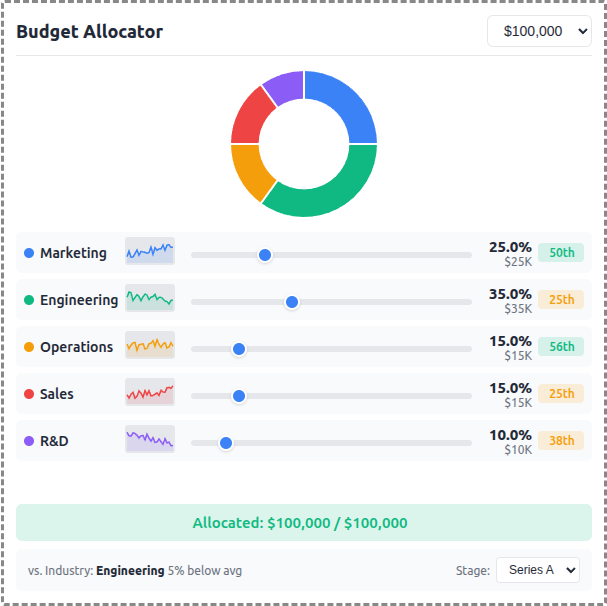
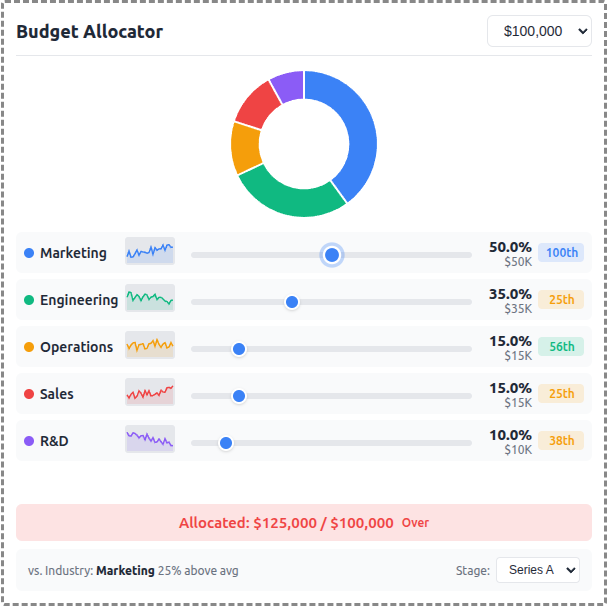
An interactive budget allocation tool demonstrating real-time data visualization with MCP Apps.
 |  |  |
MCP Client Configuration
Add to your MCP client configuration (stdio transport):
``json`
{
"mcpServers": {
"budget-allocator": {
"command": "npx",
"args": [
"-y",
"--silent",
"--registry=https://registry.npmjs.org/",
"@modelcontextprotocol/server-budget-allocator",
"--stdio"
]
}
}
}
$3
To test local modifications, use this configuration (replace ~/code/ext-apps with your clone path):
`json`
{
"mcpServers": {
"budget-allocator": {
"command": "bash",
"args": [
"-c",
"cd ~/code/ext-apps/examples/budget-allocator-server && npm run build >&2 && node dist/index.js --stdio"
]
}
}
}
Features
- Interactive Sliders: Adjust budget allocation across 5 categories (Marketing, Engineering, Operations, Sales, R&D)
- Donut Chart: Real-time visualization of allocation distribution using Chart.js
- Sparkline Trends: 24-month historical allocation data per category
- Percentile Badges: Compare your allocation vs. industry benchmarks
- Stage Selector: Switch between Seed, Series A, Series B, and Growth benchmarks
- Budget Presets: Quick selection of $50K, $100K, $250K, or $500K totals
Running
1. Install dependencies:
`bash`
npm install
2. Build and start the server:
`bash`
npm run start:http # for Streamable HTTP transport
# OR
npm run start:stdio # for stdio transport
3. View using the basic-host example or another MCP Apps-compatible host.
Architecture
$3
Exposes a single get-budget-data tool that returns:
- Category definitions with colors and default allocations
- Historical data (~120 data points) - 24 months of allocation history per category
- Industry benchmarks (~60 data points) - Aggregated percentile data by company stage
The tool is linked to a UI resource via _meta.ui.resourceUri`.
$3
- Uses Chart.js for the donut chart visualization
- Renders sparkline trends using inline SVG
- Computes percentile rankings client-side from benchmark data
- Updates all UI elements reactively on slider changes