@thi.ng/associative
v7.1.26TypeScript
ES Map/Set-compatible implementations with customizable equality semantics & supporting operations
0/weekUpdated yesterdayApache-2.0Unpacked: 71.3 KB
Published by Karsten Schmidt
npm install @thi.ng/associative!@thi.ng/associative

!npm downloads

> [!NOTE]
> This is one of 214 standalone projects, maintained as part
> of the @thi.ng/umbrella monorepo
> and anti-framework.
>
> 🚀 Please help me to work full-time on these projects by sponsoring me on
> GitHub. Thank you! ❤️
- About
- Why?
- Comparison with ES6 native types
- Status
- Installation
- Dependencies
- Usage examples
- API
- IEquivSet
- ArraySet
- LLSet
- EquivMap
- HashMap
- Authors
- License
About
ES Map/Set-compatible implementations with customizable equality semantics & supporting operations.
> [!IMPORTANT]
> In July 2024 this package was restructured and split-up to extract some
> features into smaller more focused packages:
>
> - @thi.ng/bidir-index
> - @thi.ng/object-utils
> - @thi.ng/sorted-map
> - @thi.ng/sparse-set
> - @thi.ng/trie
- Array based ArraySet, Linked List based LLSet and customizable EquivMap
& HashMap implementing the full ES6 Map/Set APIs and additional features:
- ICopy, IEmpty & IEquiv implementations
- ICompare implementation for sorted types
- multiple value additions / updates / deletions via into(), dissoc()
(maps) and disj() (sets)
- configurable key equality & comparison (incl. default implementations)
- getters w/ optional "not-found" default value
- Polymorphic set operations (union, intersection, difference) - works with both
native and custom Sets and retains their types
- Natural & selective
joins
(incl. key renaming, ported from Clojure)
Please see these packages for some example use cases:
- @thi.ng/cache
- @thi.ng/dgraph
- @thi.ng/ecs
- @thi.ng/rstream-query
$3
The native ES6 implementations use object reference identity to determine
key containment, but often it's **more practical and useful to use equivalent
value semantics** for this purpose, especially when keys are structured data
(arrays / objects).
Note: It's the user's responsibility to ensure the inserted keys are kept
immutable (even if technically they're not).
$3
``ts`
// first two objects w/ equal values
const a = [1, 2];
const b = [1, 2];
Using native implementations
`ts
const set = new Set();
set.add(a);
set.has(b);
// false
const map = new Map();
map.set(a, "foo");
map.get(b);
// undefined
`
Using custom implementations:
`ts
import { defArraySet } from "@thi.ng/associative";
const set = defArraySet();
set.add(a);
set.add({a: 1});
// ArraySet { [ 1, 2 ], { a: 1 } }
set.has(b);
// true
set.has({a: 1});
// true
`
`ts
import { defLLSet } from "@thi.ng/associative";
const set = defLLSet();
set.add(a);
set.add({a: 1});
// LLSet { [ 1, 2 ], { a: 1 } }
set.has(b);
// true
set.has({a: 1});
// true
`
`ts
import { defEquivMap, ArraySet } from "@thi.ng/associative";
// by default EquivMap uses ArraySet for its canonical keys
// const map = defEquivMap();
// with custom implementation
const map = defEquivMap(null, { keys: ArraySet });
map.set(a, "foo");
// EquivMap { [ 1, 2 ] => 'foo' }
map.get(b);
// "foo"
`
`ts
import { defHashMap } from "@thi.ng/associative";
import { hash } from "@thi.ng/vectors"
// Hash map w/ user supplied hash code function
// (here using hash function for arrays)`
const map = defHashMap([], { hash })
map.set([1, 2], "a");
map.set([3, 4, 5], "b");
map.set([1, 2], "c");
// HashMap { [ 1, 2 ] => 'c', [ 3, 4, 5 ] => 'b' }
Status
STABLE - used in production
Search or submit any issues for this package
Installation
`bash`
yarn add @thi.ng/associative
ESM import:
`ts`
import * as assoc from "@thi.ng/associative";
Browser ESM import:
`html`
For Node.js REPL:
`js`
const assoc = await import("@thi.ng/associative");
Package sizes (brotli'd, pre-treeshake): ESM: 3.13 KB
Dependencies
- @thi.ng/api
- @thi.ng/arrays
- @thi.ng/binary
- @thi.ng/checks
- @thi.ng/dcons
- @thi.ng/equiv
- @thi.ng/object-utils
- @thi.ng/transducers
Note: @thi.ng/api is in _most_ cases a type-only import (not used at runtime)
Usage examples
Four projects in this repo's
/examples
directory are using this package:
| Screenshot | Description | Live demo | Source |
|:------------------------------------------------------------------------------------------------------------------------------|:-------------------------------------------------------------------------------------------|:-------------------------------------------------------------|:------------------------------------------------------------------------------------------|
| 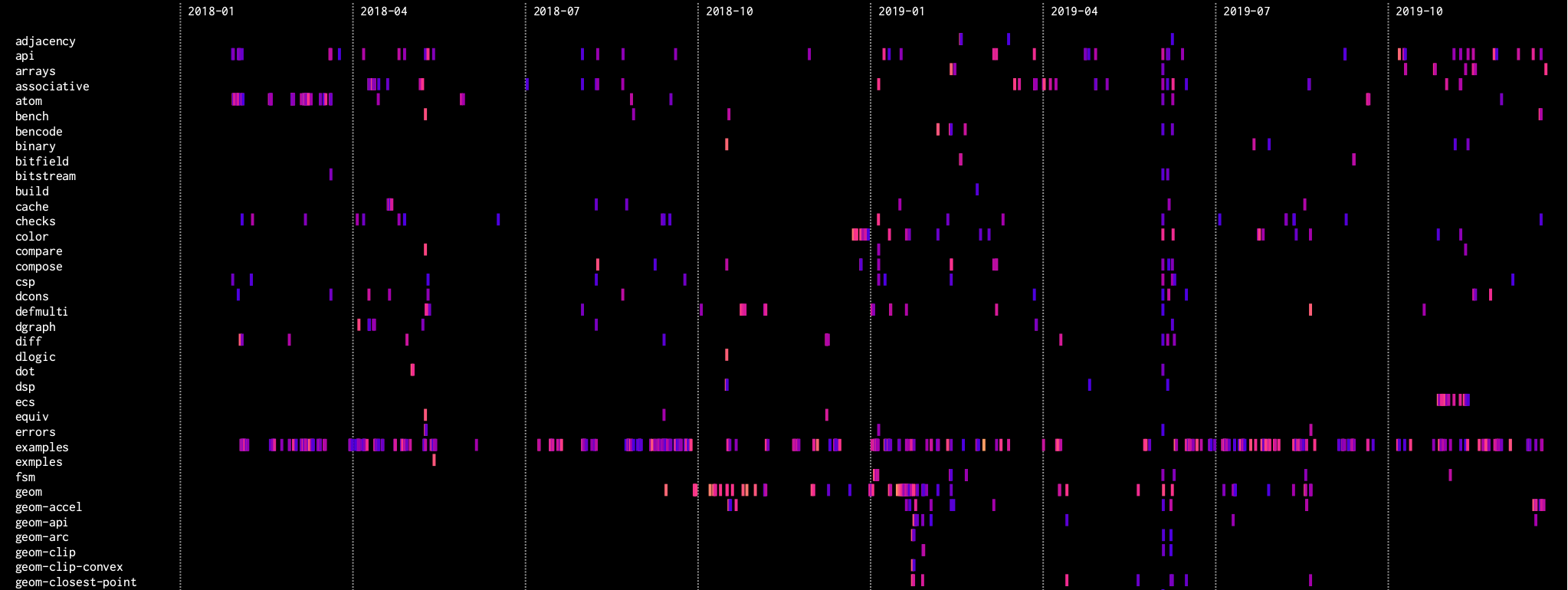 | Heatmap visualization of this mono-repo's commits | | Source |
|  | Augmenting thi.ng/geom shapes for WebGL, using instancing & attribute buffers | Demo | Source |
| 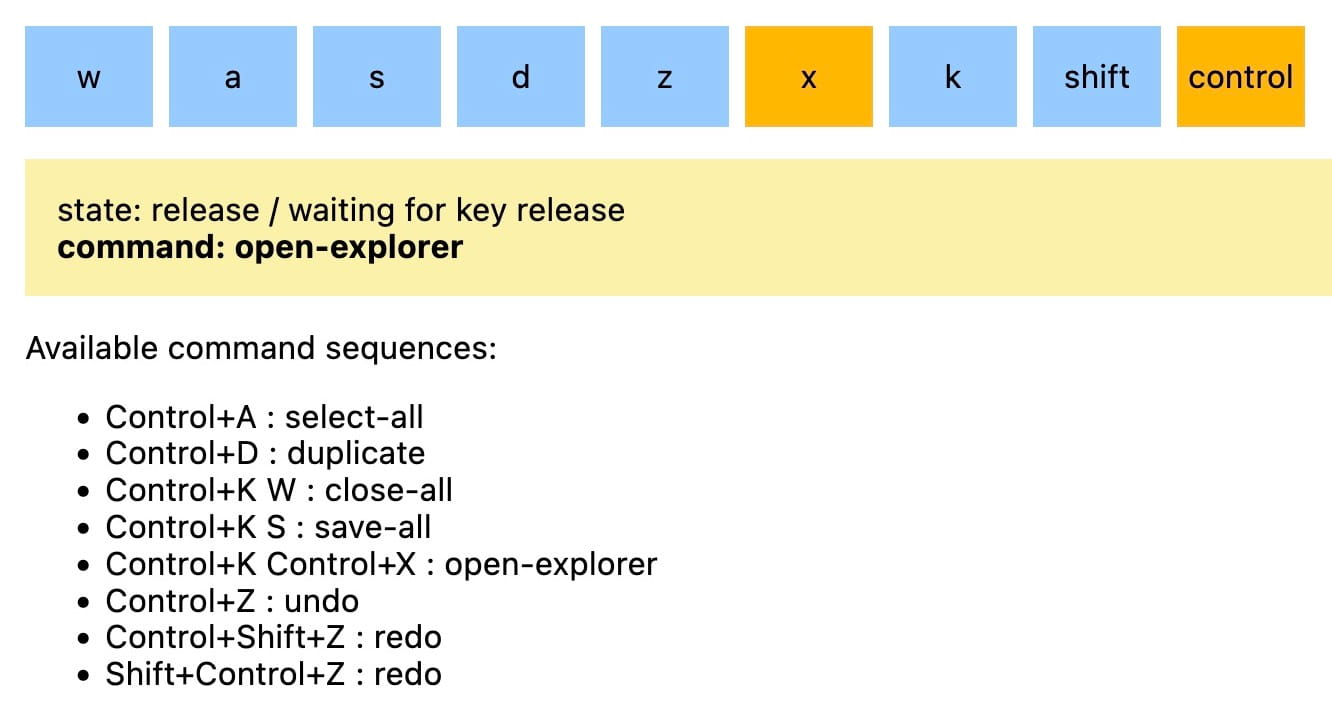 | rstream & transducer-based FSM for converting key event sequences into high-level commands | Demo | Source |
|  | Responsive image gallery with tag-based Jaccard similarity ranking | Demo | Source |
API
$3
All Set implementations in this package implement theIEquivSet
interface, an extension of the native ES6 Set API.
$3
Simple array based Set implementation which by default uses@thi.ng/equiv
for value equivalence checking.
$3
Similar to ArraySet, but uses
@thi.ng/dcons linked list
as backing storage for values.
$3
This Map implementation uses a native ES6 Map as backing storage forIEquivSet
its key-value pairs and an additional implementation forArraySet
canonical keys. By default uses for this purpose.
$3
Map implementation w/ standard ES6 Map API, supporting any key type via
hash codes computed via user supplied hash function. Uses Open
Addressing / Linear
Probing to resolve key collisions. Customizable via HashMapOpts
constructor argument. Hash function MUST be given.
Authors
If this project contributes to an academic publication, please cite it as:
`bibtex``
@misc{thing-associative,
title = "@thi.ng/associative",
author = "Karsten Schmidt",
note = "https://thi.ng/associative",
year = 2017
}
License
© 2017 - 2026 Karsten Schmidt // Apache License 2.0