@thi.ng/simd
v1.0.45TypeScript
WASM based SIMD vector operations for batch processing
0/weekUpdated yesterdayApache-2.0Unpacked: 46.0 KB
Published by Karsten Schmidt
npm install @thi.ng/simd!@thi.ng/simd

!npm downloads

> [!NOTE]
> This is one of 214 standalone projects, maintained as part
> of the @thi.ng/umbrella monorepo
> and anti-framework.
>
> 🚀 Please help me to work full-time on these projects by sponsoring me on
> GitHub. Thank you! ❤️
- About
- Available functions
- Status
- BREAKING CHANGES
- 0.4.0
- Related packages
- Installation
- Dependencies
- Usage examples
- API
- Authors
- License
About
WebAssembly SIMD vector
operations for array/batch processing, written in
AssemblyScript. These functions use
the CPU's vector instructions to process 128bit words at once, which is
the equivalent width of a 4D vector with 4x 32bit components. Several of
the provided functions can also be used to process 2D vectors.
Available functions
See
/assembly
for sources:
- abs4_f32
- add4_f32
- addn4_f32
- clamp4_f32
- clampn4_f32
- div4_f32
- divn4_f32
- dot2_f32_aos (2)
- dot4_f32_aos
- dot4_f32_soa
- invsqrt4_f32
- madd4_f32
- maddn4_f32
- mag2_f32_aos
- mag4_f32_aos
- magsq2_f32_aos
- magsq4_f32_aos
- max4_f32
- min4_f32
- mix4_f32
- mixn4_f32
- msub4_f32
- msubn4_f32
- mul4_f32
- muln4_f32
- mul_m22v2_aos (2)
- mul_m23v2_aos (2)
- mul_m44v4_aos
- neg4_f32
- normalize2_f32_aos (2)
- normalize4_f32_aos
- sqrt4_f32
- sub4_f32
- subn4_f32
- sum4_f32
- swizzle4_32 (f32 and u32)
(2) 2x vec2 per iteration
Also see
src/api.ts
for documentation about the exposed TS/JS API...
Status
ALPHA - bleeding edge / work-in-progress
Search or submit any issues for this package
The WebAssembly SIMD spec is
still WIP and (at the time of writing) only partially implemented and
hidden behind feature flags. Currently only fully tested (& testable for
me) on Node 14.6+.
- SIMD implementation status
- Node (v12.10 .. v20.7): node --experimental-wasm-simd (flag not needed anymore since v20.8)
- Chrome: Enable SIMD support via chrome://flags
$3
#### 0.4.0
Due to the opcode renumbering of SIMD
operations
proposed in April 2020, the WASM module will only work on engines released after
2020-05-21 when that change was committed to the WASM spec. For NodeJS this
means only v14.6.0 or newer will be supported. This was an external change and
outside our control...
Related packages
- @thi.ng/malloc - ArrayBuffer based malloc() impl for hybrid JS/WASM use cases, based on thi.ng/tinyalloc
- @thi.ng/soa - SOA & AOS memory mapped structured views with optional & extensible serialization
- @thi.ng/vectors - Optimized 2d/3d/4d and arbitrary length vector operations, support for memory mapping/layouts
- @thi.ng/vector-pools - Data structures for managing & working with strided, memory mapped vectors
Installation
``bash`
yarn add @thi.ng/simd
ESM import:
`ts`
import * as simd from "@thi.ng/simd";
Browser ESM import:
`html`
For Node.js REPL:
`js`
const simd = await import("@thi.ng/simd");
Package sizes (brotli'd, pre-treeshake): ESM: 2.14 KB
Dependencies
Note: @thi.ng/api is in _most_ cases a type-only import (not used at runtime)
Usage examples
One project in this repo's
/examples
directory is using this package:
| Screenshot | Description | Live demo | Source |
|:-----------------------------------------------------------------------------------------------------------------|:----------------------------------------------------------------------|:------------------------------------------------|:-----------------------------------------------------------------------------|
| 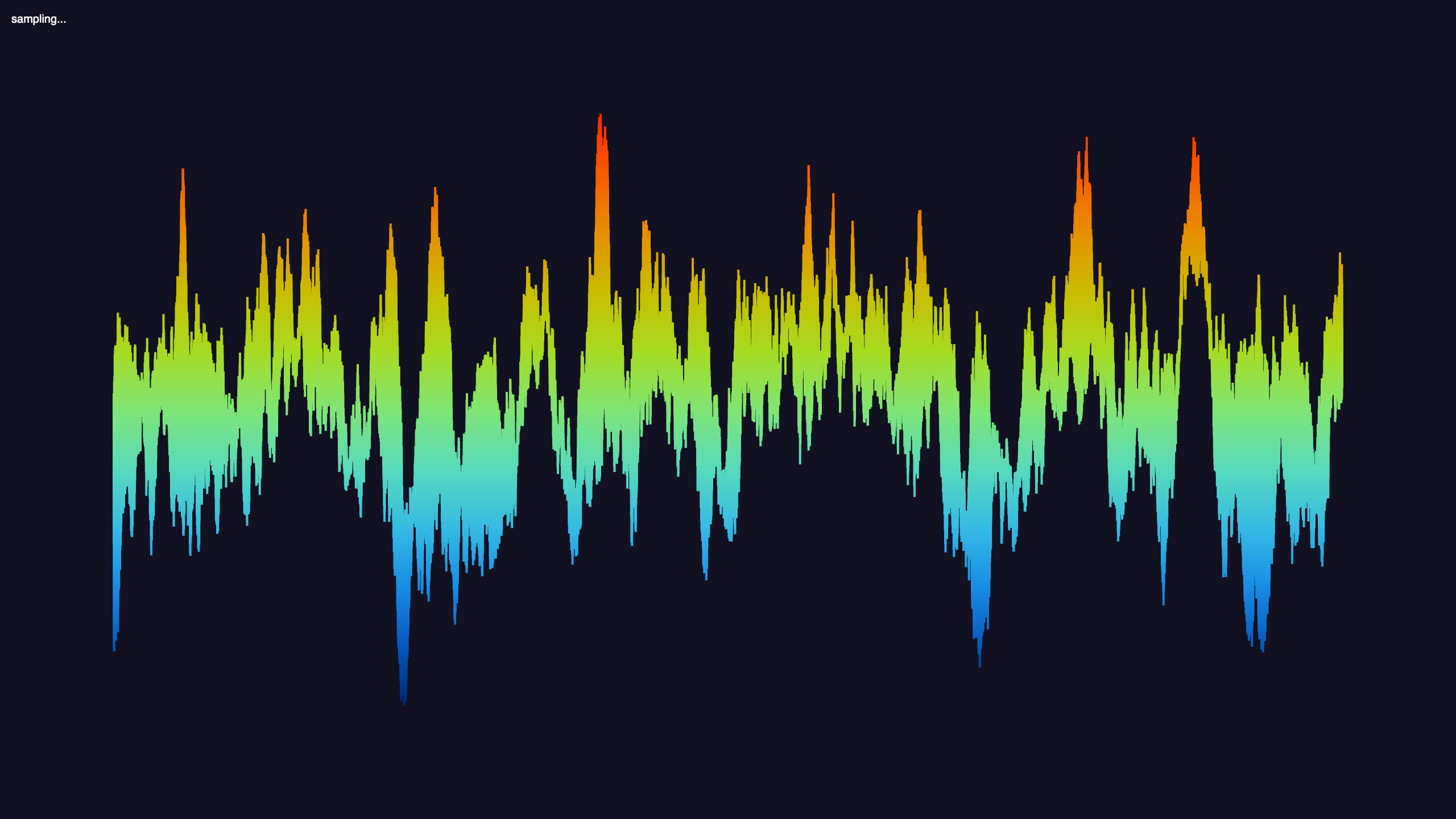 | Fitting, transforming & plotting 10k data points per frame using SIMD | Demo | Source |
API
`ts
import { init } from "@thi.ng/simd";
// the WASM module doesn't specify any own memory and it must be provided by user
// the returned object contains all available vector functions & memory views
// (an error will be thrown if WASM isn't available or SIMD unsupported)
const simd = init(new WebAssembly.Memory({ initial: 1 }));
// input data: 3x vec4 buffers
const a = simd.f32.subarray(0, 4);
const b = simd.f32.subarray(4, 16);
const out = simd.f32.subarray(16, 18);
a.set([1, 2, 3, 4])
b.set([10, 20, 30, 40, 40, 30, 20, 10]);
// compute dot products: dot(A[i], B[i])
// by using 0 as stride for A, all dot products are using the same vec
simd.dot4_f32_aos(
out.byteOffset, // output addr / pointer
a.byteOffset, // vector A addr
b.byteOffset, // vector B addr
2, // number of vectors to process
1, // output stride (floats)
0, // A stride (floats)
4 // B stride (floats)
);
// results for [dot(a0, b0), dot(a0, b1)]
out
// [300, 200]
// mat4 * vec4 matrix-vector multiplies
const mat = simd.f32.subarray(0, 16);
const points = simd.f32.subarray(16, 24);
// mat4 (col major)
mat.set([
10, 0, 0, 0,
0, 20, 0, 0,
0, 0, 30, 0,
100, 200, 300, 1
]);
// vec4 array
points.set([
1, 2, 3, 1,
4, 5, 6, 1,
]);
simd.mul_m44v4_aos(
points.byteOffset, // output addr / pointer
mat.byteOffset, // mat4 addr
points.byteOffset, // vec4 addr
2, // number of vectors to process
4, // output stride (float)
4 // vec stride (float)
);
// transformed points
points
// [110, 240, 390, 1, 140, 300, 480, 1]
`
Authors
If this project contributes to an academic publication, please cite it as:
`bibtex``
@misc{thing-simd,
title = "@thi.ng/simd",
author = "Karsten Schmidt",
note = "https://thi.ng/simd",
year = 2019
}
License
© 2019 - 2026 Karsten Schmidt // Apache License 2.0