@zaiusinc/node-sdk
v3.0.0TypeScript
Node SDK for Optimizely Data Platform
0/weekUpdated 2 months agoApache-2.0Unpacked: 507.7 KB
Published by Optimizely, Inc
npm install @zaiusinc/node-sdkA lightweight Node SDK for sending events and data to Optimizely Data Platform (ODP) from a Node JavaScript app in Optimizely Connect Platform (OCP).
> 🚧 Warning
>
> This is _not_ a browser compatible SDK. To interface with ODP from a web site, use the ODP Web SDK.
The Node SDK provides interfaces to the majority of ODP REST APIs.
Get started
Install using yarn:
``bash`
yarn add @zaiusinc/node-sdk
Or npm:
`bash`
npm install @zaiusinc/node-sdk
Migration Guide
$3
Version 3.0.0 introduces breaking changes related to the removal of the node-fetch dependency in favor of Node.js native fetch APIs.
#### Node.js Version Requirement
The minimum Node.js version has been increased:
- v2.x: Node.js >= 18.0
- v3.x: Node.js >= 22.0
Ensure your environment is running Node.js 22.0 or higher before upgrading.
#### Headers Type Changes
The Headers interface is no longer imported from node-fetch. Instead, the SDK now uses Node.js native Headers type from the global fetch API.
Before (v2.x):
`typescript
import { Headers } from 'node-fetch';
import { odp, ODP } from '@zaiusinc/node-sdk';
const response: ODP.ApiV3.HttpResponse
const headers: Headers = response.headers; // Headers from node-fetch
`
After (v3.x):
`typescript
import { odp, ODP } from '@zaiusinc/node-sdk';
const response: ODP.ApiV3.HttpResponse
const headers: Headers = response.headers; // Native Node.js Headers (global)
`
The native Headers type is available globally in Node.js 18+ and provides the same standard Fetch API Headers interface.
#### Dependency Changes
The node-fetch package has been completely removed. If your code was directly importing or using node-fetch alongside this SDK, you can:
1. Remove node-fetch and @types/node-fetch from your dependencies if they're no longer neededfetch()
2. Use Node.js native which is available globally in Node.js 18+Headers
3. Use the native , Request, and Response types from the global scope
This is not mandatory, but that'll help get rid of one more dependency from the package.
Example:
`typescript`
// No need to import fetch or Headers anymore
const response = await fetch('https://api.example.com/data');
const headers = new Headers({
'Content-Type': 'application/json'
});
Usage
To communicate with ODP, you need to obtain and configure an instance of ODPClient. odp
There are two ways to do this:
1. Use module scoped instance exported as from the SDK.ODPClient
2. Create your own instance of .
Using module scoped instance is easier, when you don't need to communicate with multiple ODP accounts.
With module scoped instance, you configure the SDK once and then use it throughout your application.
If you're using the Node SDK in an OCP app, module scope comes pre-configured with the private API key.
Creating your own instance of ODPClient gives you more control.
$3
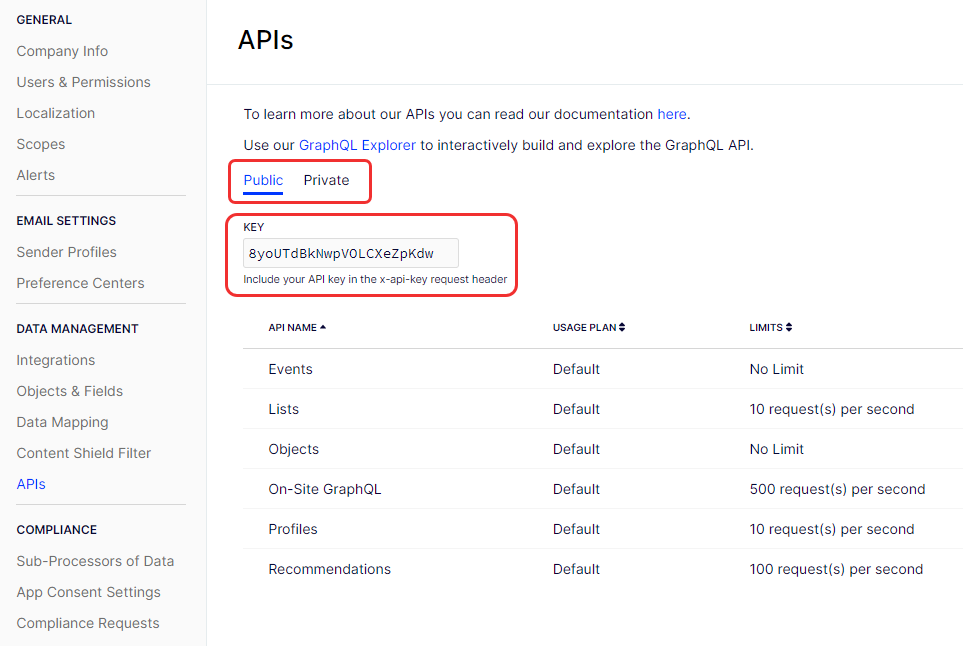
You need to configure the SDK with your API keys.
If you are only sending data to ODP, you normally only need your public API key, however, some API calls require your private API key.
You can obtain these from the Account Settings > APIs page in the ODP app.
#### Using module scoped instance
`typescript
import {odp} from '@zaiusinc/node-sdk';
odp.configure({
apiKey: 'your_public_or_private_api_key'
});
const event = {type: 'pageview', identifiers: {email}, data: {page}};
await odp.event(event);
`
Alternatively, you can provide the apiKey as an environment variable ODP_SDK_API_KEY and omit cofigure method.
> Note
> For compatibility with previous versions of the SDK, module scoped instance is also exported as z from the SDK.
> Note
> Calling configure method is not needed when using the ODP Node SDK in an OCP app.
> The SDK is pre-configured with the private API key.
#### Creating your own instance of ODPClienttypescript
import {ODPClient} from '@zaiusinc/node-sdk';
const odp = new ODPClient({
apiKey: 'your_public_or_private_api_key'
});
const event = {type: 'pageview', identifiers: {email}, data: {page}};
await odp.event(event);
`
Alternatively, you can provide the apiKey as an environment variable ODP_SDK_API_KEY and use parameterless constructor.
Typescript
The ODP Node SDK is TypeScript first, so no need to install or create additional type definitions.
To access the exported types, import ODP from the SDK.
`typescript
import {odp, ODP} from '@zaiusinc/node-sdk';
async function pageview(email: string, page: string) {
const event: ODP.Event = {type: 'pageview', identifiers: {email}, data: {page}};
const result = await odp.event(event);
return result.success;
}
`
> Note
> For compatibility with previous versions of the SDK, types are also exported as Zaius from the SDK.
Available APIs
`javascript
import {odp} from '@zaiusinc/node-sdk';
/**
* Configure the OCP Node SDK for use
*/
odp.configure(sdkConfig);
/**
* Access public values of the current configuration
*/
odp.config;
/**
* Send an event to ODP using the v3 event API
*/
odp.event(eventPayload);
odp.event(eventPayload[]);
/**
* Create or update a customer profile in ODP using the v3 profiles API
*/
odp.customer(customerPayload, options);
odp.customer(customerPayload[], options);
/**
* Create or update an object in ODP using the v3 objects API
*/
odp.object(type, objectPayload, options);
/**
* Manage schema (ODP domain objects and fields) using the v3 APIs
*/
odp.schema.createField(object, field);
odp.schema.createIdentifier(identifier);
odp.schema.getEnabledModules();
odp.schema.enableModule(moduleName);
odp.schema.getObject(name);
odp.schema.getAllObjects();
odp.schema.createObject(objectDefinition);
odp.schema.createRelation(object, relationDefinition);
/**
* Manage customer identifiers using the v3 APIs
*/
odp.identifier.updateMetadata(identifierUpdates);
odp.identifier.getMetadata(identifierFieldName, identifierValue);
odp.identifier.updateReachability(reachabilityUpdates);
odp.identifier.getReachability(identifierFieldName, identifierValue);
odp.identifier.updateConsent(consentUpdates);
odp.identifier.getConsent(identifierFieldName, identifierValue);
/**
* Manage list subscriptions using the v3 APIs
*/
odp.list.createList(listName);
odp.list.getLists(listName);
odp.list.subscribe(listId, identifiers);
odp.list.unsubscribe(listId, identifiers);
odp.list.updateSubscriptions(listId, arrayOfUpdates);
/**
* Query data using the GraphQL API
*/
odp.graphql
`
Use APIs that the OCP Node SDK does not support
If you need to use an API that is not supported by the ODP Node SDK yet, you can
follow the ODP REST API documentation
and use the v3Api helper to query the APIs directly. For example:
`typescript``
await odp.v3Api.post('objects/products', [
{
product_id: '123',
name: 'Red Shirt'
},
{
product_id: '456',
name: 'Blue Shirt'
}
]);