angular-material-styles
v1.1.21
The AngularJS Material project is an implementation of Material Design in AngularJS. This project provides a set of reusable, well-tested, and accessible Material Design UI components. AngularJS Material is supported internally at Google by the AngularJS,
0/weekUpdated 3 years agoMITUnpacked: 801.0 KB
Published by miguelcobain
npm install angular-material-stylesMaterial Design for AngularJS Apps


Material Design is a specification for a
unified system of visual, motion, and interaction design that adapts across different devices. Our
goal is to deliver a lean, lightweight set of AngularJS-native UI elements that implement the
material design specification for use in AngularJS single-page applications (SPAs).
AngularJS Material is an implementation of Google's
Material Design Specification (2014-2017)
for AngularJS developers.
For an implementation of the Material Design Specification (2018+),
please see the Angular Material project which is built for
Angular developers.
AngularJS Material includes a rich set of reusable, well-tested, and accessible UI components.
Quick Links:
* API & Demos
* Contributing
* Building
* Installing
Please note that using AngularJS Material requires the use of **AngularJS
1.4.x** or higher.
AngularJS Material is targeted for the browser versions defined in the browserslist field
of our package.json. Below is a screenshot from
browserl.ist
that provides a visual representation of this configuration:
!AngularJS Material Browser Support
Online Documentation and Demos
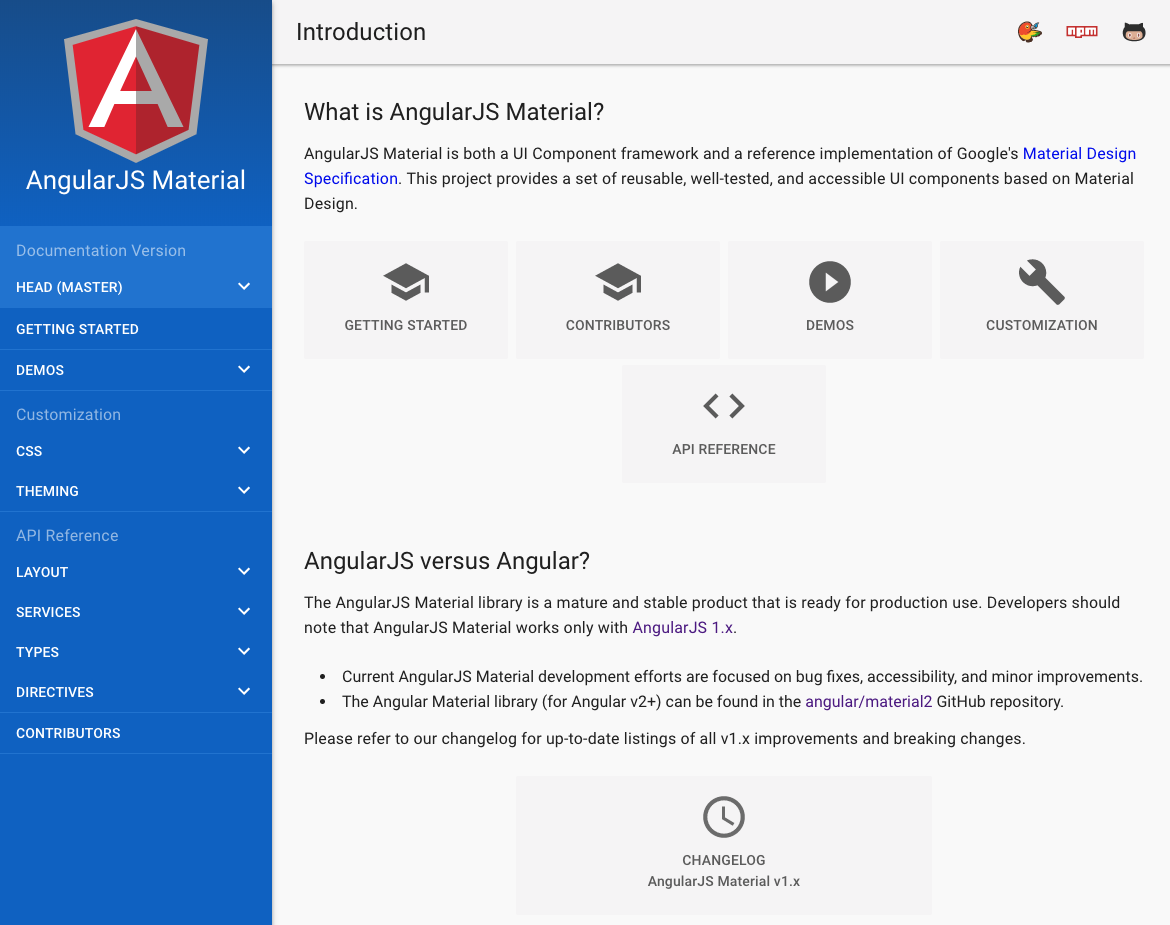
- Visit material.angularjs.org online to review the API, see the
components in action via live demos, and to read our detailed guides which include the layout system,
theming system, typography, and more.
- Or you can build the documentation and demos locally; see
Build Docs & Demos for details.
Our Release Processes
To preserve stability with applications currently using AngularJS Material, we do not follow semver.
We have three types of releases:
* major : major releases will be done in the separate Angular Material repo.
This type of release will not be used within AngularJS Material.
* minor: contain breaking changes in addition to patch release changes.
* patch: non-breaking changes (no API, CSS, UX changes that will cause breaks in existing AngularJS Material applications).
##### Patch Releases
The patch builds (1.1.8, 1.1.9, 1.1.10, etc.) are prepared based on commits in the master branch;
which contains only non-breaking changes (I.e. bug fixes, new features, API additions, and minimal
non-breaking CSS changes). We are targeting patch releases every 2 weeks.
##### Minor Releases
The minor builds (1.1.0, 1.2.0, 1.3.0) can contain breaking changes to CSS, APIs, and UX.
Our formal release of minor builds is much less frequent. The release process for minor builds is currently
being re-evaluated.
> For the purposes of AngularJS Material, you could think of the patch releases as being minor changes
and the 'minor' releases as being major changes according to semver.
Contributing
Developers interested in contributing should read the following guidelines:
- Issue Guidelines
- Contributing Guidelines
- Coding Guidelines
- Pull Request Guide
- Software Process
- Change Log
> Please do not ask general questions in an issue. Issues are only to report bugs, request
enhancements, or request new features. For general questions and discussions, use the
AngularJS Material Forum.
It is important to note that for each release, the ChangeLog is a resource that will
itemize all:
- Bug Fixes
- New Features
- Breaking Changes
Building
Developers can build AngularJS Material using NPM and gulp.
First install or update your local project's npm dependencies:
``bash`
npm install
Then run the gulp tasks:
`bashangular-material.js/.cssTo build
and Theme files in the /dist directory
gulp build
To build the AngularJS Material Docs and Demos in /dist/docs directory
gulp docs
`
For development, use the
NPM script to run in dev mode:`bash
To build the AngularJS Material Source, Docs, and Demos in watch mode
npm run docs:watch
`For more details on how the build process works and additional commands (available for testing and
debugging) developers should read the Build Guide.
Installing Build (Distribution Files)
#### NPM
For developers not interested in building the AngularJS Material library... use NPM to install
and use the AngularJS Material distribution files.
Change to your project's root directory.
bash
To get the latest stable version, use Bower from the command line.
npm install angular-material --saveTo get the most recent, latest committed-to-master version use:
npm install http://github.com/angular/bower-material#master --save
`#### Other Dependency Managers
Visit Bower-Material for more
details on how to install and use the AngularJS Material distribution files within your own local
project.
This includes instructions for Bower
and JSPM.
#### CDN
CDN versions of AngularJS Material are now available.
With the Google CDN, you will not need to download local copies of the distribution files. Instead
simply reference the CDN urls to easily use those remote library files. This is especially useful
when using online tools such as CodePen, Plunker, or
JSFiddle.
html
`Developers seeking the latest, most-current build versions can use GitCDN.xyz to
pull directly from the distribution GitHub
Bower-Material repository:
html
`Once you have all the necessary assets installed, add
and ngMessages as dependencies for your app:`javascript
angular.module('myApp', ['ngMaterial', 'ngMessages']);
``