cytoscape-select
v3.26.9TypeScript
Graph theory (a.k.a. network) library for analysis and visualisation
0/weekUpdated 2 years agoMITUnpacked: 4.6 MB
Published by alex_w_00
npm install cytoscape-select


Created at the University of Toronto and published in Oxford Bioinformatics (2016, 2023).
Authored by: Max Franz, Christian Lopes, Dylan Fong, Mike Kucera, ..., Gary Bader
Cytoscape.js
Graph theory (network) library for visualisation and analysis : https://js.cytoscape.org
Description
Cytoscape.js is a fully featured graph theory library. Do you need to model and/or visualise relational data, like biological data or social networks? If so, Cytoscape.js is just what you need.
Cytoscape.js contains a graph theory model and an optional renderer to display interactive graphs. This library was designed to make it as easy as possible for programmers and scientists to use graph theory in their apps, whether it's for server-side analysis in a Node.js app or for a rich user interface.
You can get started with Cytoscape.js with one line:
``js`
var cy = cytoscape({ elements: myElements, container: myDiv });
Learn more about the features of Cytoscape.js by reading its documentation.
Example
The Tokyo railway stations network can be visualised with Cytoscape:
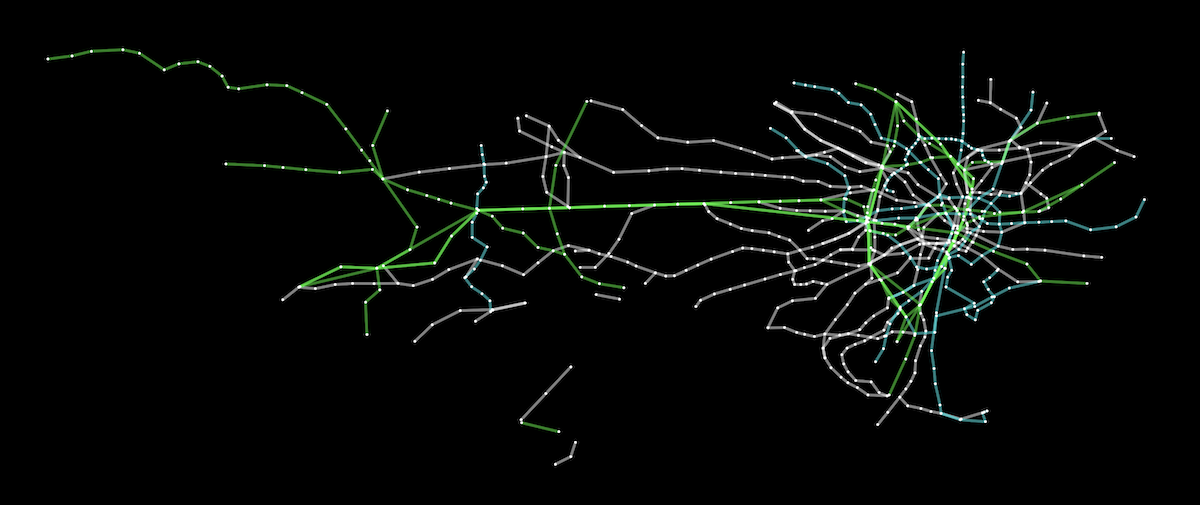
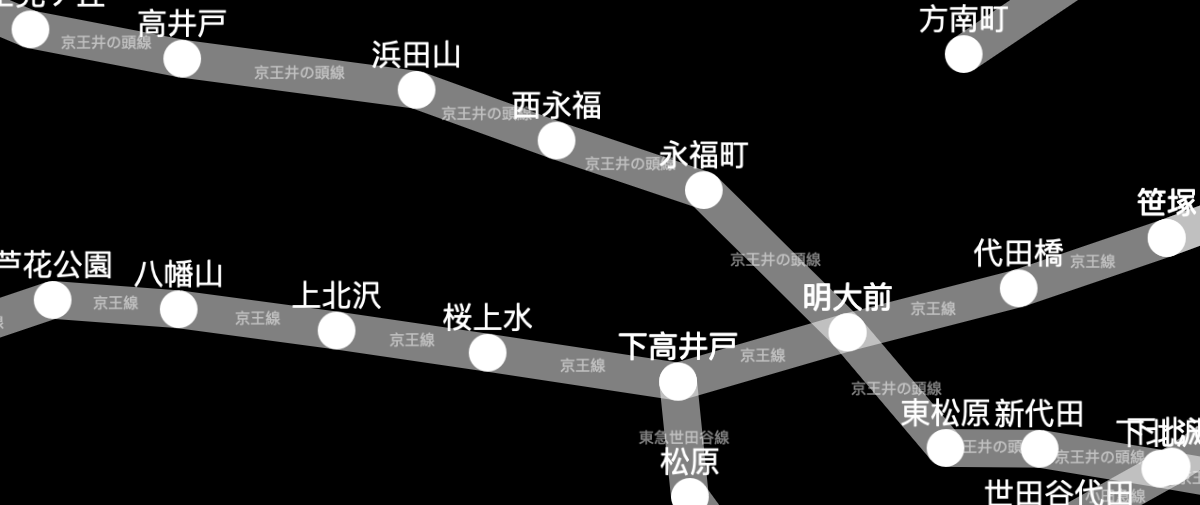
A live demo and source code are available for the Tokyo railway stations graph. More demos are available in the documentation.
Documentation
You can find the documentation and downloads on the project website.
Roadmap
Future versions of Cytoscape.js are planned in the milestones of the Github issue tracker. You can use the milestones to see what's currently planned for future releases.
Contributing to Cytoscape.js
Would you like to become a Cytoscape.js contributor? You can contribute in technical roles (e.g. features, testing) or non-technical roles (e.g. documentation, outreach), depending on your interests. Get in touch with us by posting a GitHub discussion.
For the mechanics of contributing a pull request, refer to CONTRIBUTING.md.
Feature releases are made monthly, while patch releases are made weekly. This allows for rapid releases of first- and third-party contributions.
Citation
To cite Cytoscape.js in a paper, please cite the Oxford Bioinformatics issue:
Cytoscape.js: a graph theory library for visualisation and analysis
Franz M, Lopes CT, Huck G, Dong Y, Sumer O, Bader GD
Bioinformatics (2016) 32 (2): 309-311 first published online September 28, 2015 doi:10.1093/bioinformatics/btv557 (PDF)
- PubMed abstract for the original 2016 article
- PubMed abstract for the 2023 update article
Build dependencies
Install node and npm. Run npm install before using npm run.
Build instructions
Run npm run in the console. The main targets are:
Building:
* build: do all builds of the library (umd, min, umd, esm)build:min
* : do the unminified build with bundled dependencies (for simple html pages, good for novices)build:umd
* : do the umd (cjs/amd/globals) buildbuild:esm
* : do the esm (ES 2015 modules) buildclean
* : clean the build directorydocs
* : build the docs into documentation
* : build all release artifactswatch
* : automatically build lib for debugging (with sourcemap, no babel, very quick)debug/index.html
* good for general testing on
* served on or the first available port thereafter, with livereload on debug/index.html
* : automatically build lib for debugging (with sourcemap, with babel, a bit slower)http://localhost:8080
* good for testing performance or for testing out of date browsers
* served on or the first available port thereafter, with livereload on debug/index.html
* : automatically build prod umd bundle (no sourcemap, with babel)"cytoscape": "file:./path/to/cytoscape"
* good for testing cytoscape in another project (with a reference in your project's package.json)dist
* no http server
* : update the distribution js for npm etc.
Testing:
The default test scripts run directly against the source code. Tests can alternatively be run on a built bundle. The library can be built on node>=6, but the library's bundle can be tested on node>=0.10.
* test : run all testing & lintingtest:js
* : run the mocha tests on the public API of the lib (directly on source files)npm run test:js -- -g "my test name"
* runs tests on only the matching test casestest:build
* : run the mocha tests on the public API of the lib (on a built bundle) npm run build
* should be run beforehand on a recent version of nodenpm run test:build -- -g "my test name"
* runs build tests on only the matching test casestest:modules
* : run unit tests on private, internal APInpm run test:modules -- -g "my test name"
* runs modules tests on only the matching test caseslint
* : lint the js sources via eslintbenchmark
* : run all benchmarksbenchmark:single
* : run benchmarks only for the suite specified in benchmark/single
Release instructions
1. Ensure the docs are updated with the list of releases you would like to make in documentation/md/intro.md (on both master and unstable branches). Push the changes.git checkout 1.1.x
1. Ensure that milestones exist for the releases that you would like to make. Each milestone should contain its corresponding issues and pull requests.
1. For patch releases, do the back-port patch release before the corresponding current release. This ensures that npm lists the current version as the latest one.
1. , e.g. if the previous feature release is 1.1master
1. Follow the remaining ordinary release steps (step 5 and onward).
1. Current releases are based on the branch: git checkout master
1. If you are making a patch release, you can just release with its new patches.unstable
1. If you are making a feature release, you need to merge onto master. Since there can be conflicts, it's easiest to use the 'ours' strategy which will allow you to use the state of unstable as-is (i.e. no conflict resolution necessary):master
1. Make sure your local is up-to-date: git checkout master && git pull
1. Make sure your local is up-to-date: git checkout unstable && git pull
1. Create a merge commit that selects the state of and push it: git merge -s ours master && git push
1. Fast-forward to the merge commit: git checkout master && git merge unstable && git push
1. Update the version number in and package-lock.json on unstable to some provisional new version number, and push it.VERSION
1. Update the environment variable for the release number you want to make, e.g. export VERSION=1.2.3
 1. Confirm all the tests are passing:
     1.
1. See also for browser testing (optional)npm run watch:umd
1. Confirm all the tests are passing in IE9 (for feature releases):
1.
     1. Open an IE9 VM
1. Open in IEnpm run release
1. Prepare a release:
 1. Review the files that were just built in the previous step.
1. There should be a series of updated files in the directory and the documentation directory, identified with git status. git add . && git commit -m "Build $VERSION"
1. Try out the newly-built docs and demos in your browser.
1. Add the the release to git:
1. Update the package version and tag the release:
1. Push the release changes:
1. Publish the release to npm:
 1. Create a release for Zenodo from the latest tag.  Make sure you wait at least 5 minutes since the last time that you made a release in order for Zenodo to work properly.
 1. For feature releases:  Create a release announcement on the blog.  Share the announcement on mailing lists and social media.
Tests
Mocha tests are found in the test directory. The tests can be run in the browser or they can be run via Node.js (npm run test:js`).