html-pages
v3.1.0
Simple development HTTP Server for file serving and directory listing made by a Designer. Use it for hacking your HTML/JavaScript/CSS files but not for deploying your final site.
0/weekUpdated 3 years agoMITUnpacked: 7.9 MB
Published by Daniel Cardoso
npm install html-pages

HTML Pages
Simple development http server for file serving and directory listing made by a Designer. Use it for hacking your HTML/JavaScript/CSS files, but not for deploying your final site.
Visit HTML Pages »
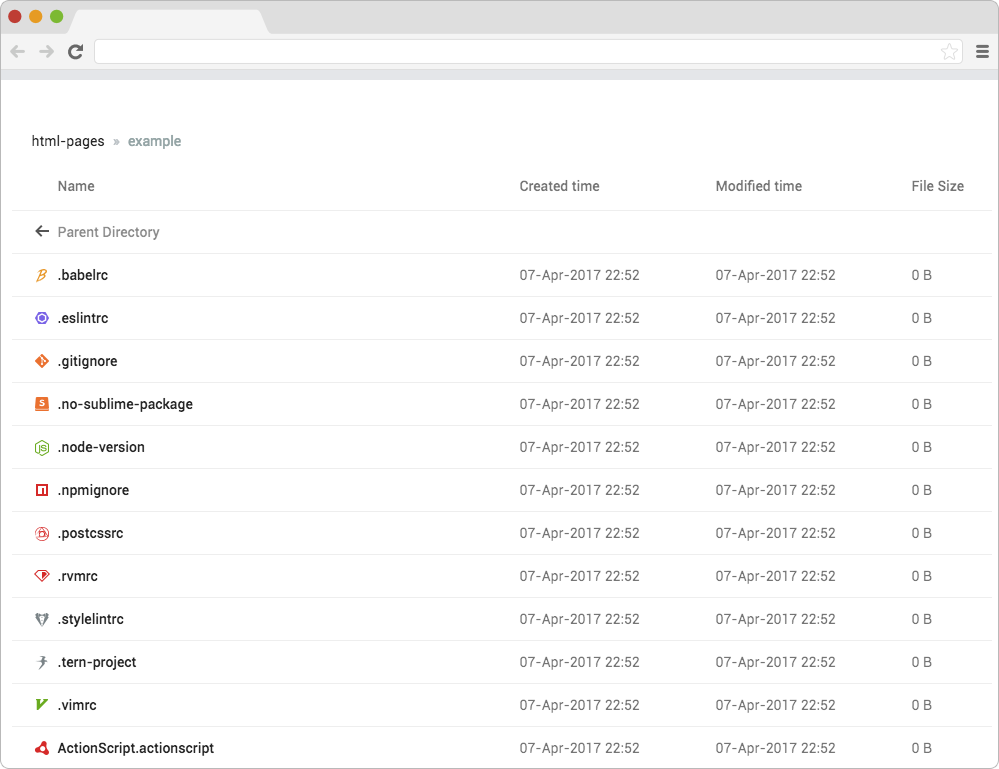
Table of contents
- Status
- Quick start
- Usage from command line
- What next?
- Version history
- Author
Status


Quick start
Each of us already wanted to share a certain directory on our network by running just a command little command, Am I right? Then this module is exactly what you're looking for: It provides a beautiful interface for listing the directory's contents and switching into sub folders.
In addition, it's also awesome because it comes to serving static sites. If a directory contains an index.html, html-pages will automatically render it instead of serving directory contents, and will serve any .html file as a rendered page instead of file's content as plaintext.
Another huge reason to use this package is that AJAX requests don't work with the file:// protocol due to security restrictions, i.e. you need a server if your site fetches content through JavaScript.
#### Installation
You need to have node.js (>v.6.6.0) and npm installed. You should probably install this globally.
Npm way
``bash`
npm install -g html-pages
This will install html-pages globally so that it may be run from the command line.
Manual way
`bash`
git clone https://github.com/danielcardoso/html-pages
cd html-pages
npm install # Local dependencies if you want to hack
npm install -g # Install globally
Usage from command line
You just have to call the command html-pages in your project's directory. Alternatively you can add the path to be a command line parameter.
#### Command line parameters
Run this command to see a list of all available options:
`bash`
html-pages --help
###### Options
* -a, --auth — Enables http-auth using the PAGES_USER and PAGES_PASSWORD environment variables-b, --browser
string* — Specify browser to use instead of system default-c, --cache
number* — Time in milliseconds for caching files in the browser (defaults to 3600)-C, --cors
* — Setup CORS headers to allow requests from any origin-d, --directory-index
file* — The index file of a directory. Set to empty "" to always show the directory listing (defaults to index.html)-h, --help
* — Output usage information-i, --ignore
string/array* — Files and directories to ignore. Use a string (comma-separated string for paths to ignore) if your are using the command line and an array if you are calling it via API-L, --layout
string* — Specify the page layout. Available options grid or list. (defaults to-l, --log-level
grid)
string* — Display logs in the console. The possible values are silent, error, warn, info, debug. Any logs of a higher level than the setting are shown. If you define it as info, it will show warn and error outputs also. (defaults to info)silent
* - It will suppress all application logging. The Fatal errors will be shown.error
* - Any error which is fatal to the operation, but not the service or application (can't open a required file, missing data, etc.). These errors will force user (administrator, or direct user) intervention. These are usually reserved (in my apps) for incorrect connection strings, missing services, etc.warn
* - Anything that can potentially cause application oddities, but for which I am automatically recovering. (Such as switching from a primary to backup server, retrying an operation, missing secondary data, etc.)info
* - Generally useful information to log (service start/stop, configuration assumptions, etc). Info I want to always have available but usually don't care about under normal circumstances. This is my out-of-the-box config level.debug
* - Information that is diagnostically helpful to people more than just developers (IT, sysadmins, etc.).-o, --open
* — Open browser window after starting the server--no-cache
* — Disabled the caching files in the browser--no-clipboard
* — Don't copy address to clipboard--no-listing
* — Turn off the directory listings--no-notifications
* — Suppress automatic notifications launching--no-port-scan
* — Disabled the port scanning when the selected port is already in use-p, --port
number* — Port to listen on (defaults to 8084)-r, --root
string* — The root directory (defaults to ./)-S, --silent
* — Set log-level to silent mode-u, --unzipped
* — Disable GZIP compression-V, --verbose
* — Set log-level to debug mode-v, --version
* — Output the version number
Default options:
If a file ~/.html-pages.json exists it will be loaded and used as default options for html-pages on the command line. See Options for option names.
#### Authentication
If you set the --auth flag, this package will look for a username and password in the PAGES_USER and PAGES_PASSWORD environment variables.
As an example, this is how such a command could look like:
`bash`
PAGES_USER=daniel PAGES_PASSWORD=1904 html-pages --auth
Usage from node
You can also use the package inside your application. Just load it:
`js`
const pages = require('html-pages')
And call it with flags (check Command line parameters for the full list):
`js`
const pagesServer = pages(__dirname, {
port: 1904,
'directory-index': '',
'no-clipboard': true,
ignore: ['.git', 'node_modules']
})
To stop the server just use the method:
`js`
pagesServer.stop()
What next?
* Enable HTTPS support;
* Add Proxy support;
Provide a /robots.txt (whose content defaults to 'User-agent: \nDisallow: /');
* Improve HTML errors;
Version history
* v2.1.0
- Security updates
* v2.0.0
- Specify the page layout. Available options grid or list
- Add address to bind to. By default it supports "any address"localhost
- Add option to work only locally, blocking external connectionslog-level
- Disable notification by default
- Minor improvements
* v1.7.0
- Logs all requests: add options , verbose and silent to filter the logs--no-browser
- Minor improvements
* v1.6.0
- Replace the option with the --open or -o
  - Added some logging to console
  - Improve HTML errors
  - Minor improvements
* v1.5.0
  - Using Travis CI (Linux and Mac Build Status)
  - Using AppVeyor (Windows Build Status)
  - CORS support
  - Load initial settings from
- Minor improvements
- Improve tests
* v1.4.0
- Update dependencies
* v1.3.0
- Code Refactoring
* v1.2.0
- Add web browser launching support:
- it uses opn to allow opening links in different browsers;
- Minor improvements
* v1.1.0
- Add icons with the file types to the directory listing;
- Add example files;
* v1.0.0
- Initial release
Author
Daniel Cardoso (@DanielCardoso) - DanielCardoso.net