npm install js-ganttjs-gantt


Library to create easy to configure and use simple Gantt-Charts. The created Gantt-Charts can be used to visualize multiple time-intervals.
The rich configuration allows among other things:
- customizable axes labeling,
- modifiable sizing for all visual components (i.e., intervals, swim-lanes, chart, axes)
- rule-based coloring,
- tooltip configuration, and
- many many more.
How to Install
The library can be used with bower, requireJs or as individual JavaScript Import. The following paragraphs
explain how to use the library in the different scenarios.
$3
``
bower install --save js-gantt
The library will be added to your bower-components. By default the js-gantt.js is selected as single main file, which is thejs-gantt.min.hs
not minified version of the library (the minified/uglified version is ). Examples on how to use the library can
be found here.
$3
If you are building larger web-applications and you want to enjoy the advantage of requireJs, you
need to include the sources (and not the optimized libraries). To do so, you may download the tarball or a zip-archive from
GitHub and place it into your scripts folder. You can also utilize npm or bower to download the sources automatically main
and override the configuration (see here). You can then require the needed library as following:
`javascript`
require(['net/meisen/ui/gantt/GanttChart'], function (SvgLibrary) {
var gantt = new GanttChart();
});
$3
If you simple want to use the library within your web-site, you can easily do so by downloading it, deploying it on your
server and adding tags:
`html`
The library is bound to the window instance and thus is directly available for any other script:
`html
`
If you'd like to have this library available through a CDN, please Star the project.
Usage Examples
Here are some jsFiddle examples utilizing the library. All examples are purely based
on this library, no additional dependencies needed.
$3
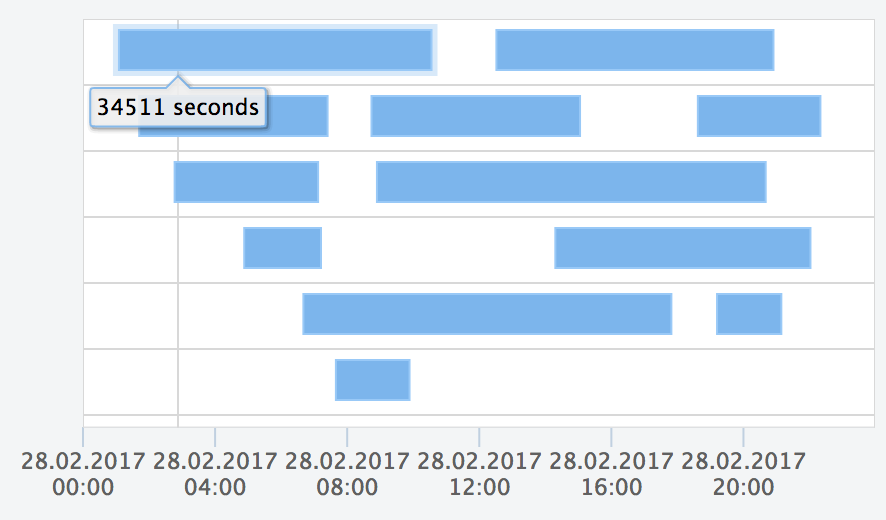
https://jsfiddle.net/pmeisen/pfg7t1uw/
This example demonstrates how easy it is to use the library and config some different aspects like:
- data:
- loading of data
- mapping
- time-axis
- illustrator:
- scrollbars
- axis
- theme (interval size)
$3
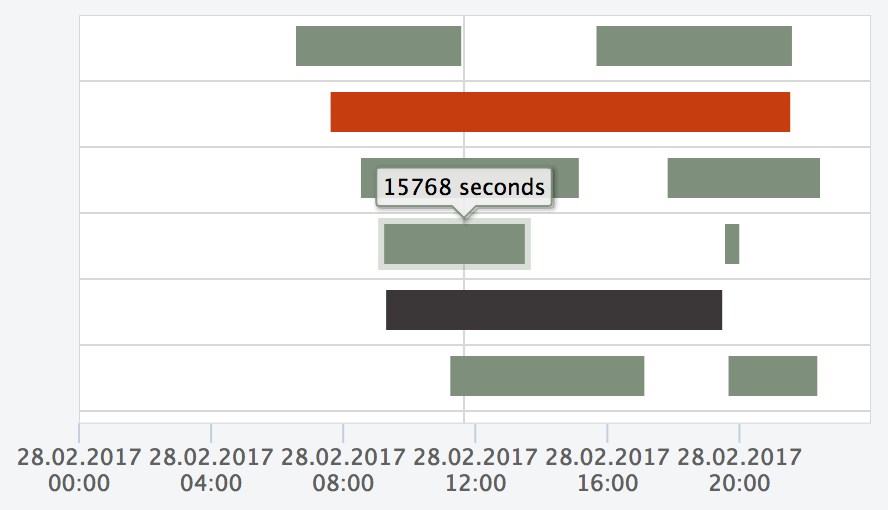
https://jsfiddle.net/pmeisen/sL7dckbs/
The example shows how to use the colorizer to specify rule-based colors for the intervals. You simple have to override the default-configurationcolorizer
of the , which is done in the example (see Configuration for further information):
`javascript`
var config = {
illustrator: {
config: {
view: {
coloring: {
colorizer: function (interval, map, defaultColor) {
var record = interval.get(IntervalView.gRawAttr);
var value = map.val('label', record);
var n = parseInt(value);
if (n > 0 && n <= 25000) {
return '#7E8F7C';
} else if (n > 25000 && n <= 50000) {
return '#3B3738';
} else if (n > 50000 && n <= 90000) {
return '#C63D0F';
} else {
return defaultColor;
}
}
}
}
}
}
};
$3
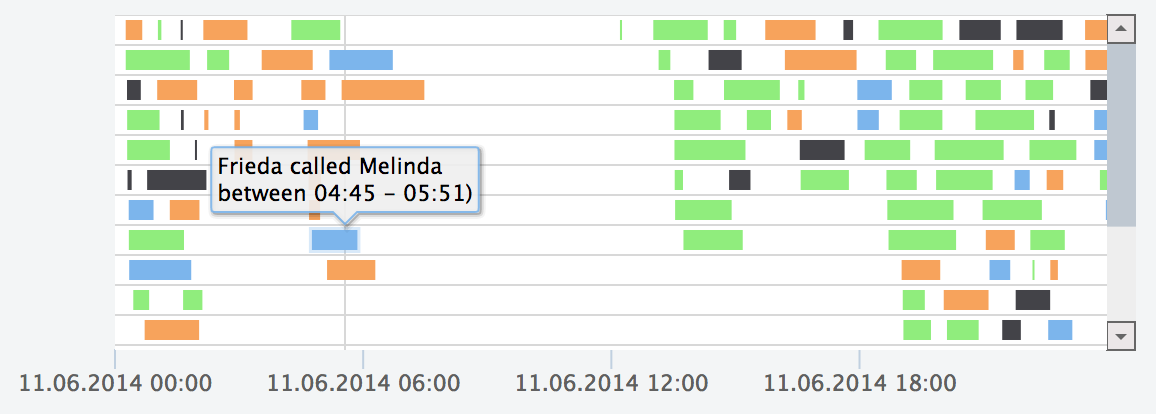
https://jsfiddle.net/pmeisen/r16qfrnx/
Most often an external data source is used to visualize data. The library expects the data to be in JSON Array form, i.e.:
`json`
[
["Clara","11.06.2014 00:15:32","11.06.2014 00:39:32",24,"Tristan","Maryland","Tajikistan",0.22,5.28,"United States","Asia","Female","Male" ],
["Niklas","11.06.2014 00:15:35","11.06.2014 01:48:35",93,"Jesko","Florida","Tuvalu",1.84,171.12,"United States","Oceania","Male","Male" ],
["Niklas","11.06.2014 00:17:25","11.06.2014 00:37:25",20,"Anni","Florida","Cayman Islands",0.24,4.8,"United States","Oceania","Male","Female" ],
]
There are several good online tools to convert different formats into a JSON data form, e.g., for CSV convertcsv.com.
Nevertheless, sometimes the data that you receive, e.g., from an url is not in JSON form. For that scenario, the library's provides a configuration, which
allows you to post-process JSON data, e.g., retrieved from a web-service. In the jsFiddle, the loaded data is post-processed via the following function:
`javascript`
var config = {
data: {
postProcessor: function (data) {
var f = 'dd.MM.yyyy HH:mm:ss';
for (var i = 0; i < data.length; i++) {
var record = data[i];
record[1] = GanttChart.DateUtil.parseString(record[1], f);
record[2] = GanttChart.DateUtil.parseString(record[2], f);
}
return {
names:['caller', 'start', 'end',
'duration', 'recipient', 'origin',
'destination', 'ratepermin', 'costs',
'origincontinent', 'destinationcontinent',
'callergender','recipientgender'],
records: data
};
}
}
};
The post-processor expects an object defining the names and records. The names are an array naming the differentDate
values of each record. It can be understood as the header of a CSV-file. In the records, the named values representing the
start and end value of the interval, must be a .
If the returned data is not a JSON, the library offers a loader configuration, which defines how to load data. The loader
must be implemented as:
`
var config = {
	data: {
        postProcessor: function (success, error) {
            // success and error are both function, with:
            // - success: function(data);
            // - error:   function(msg);
        }
    }
};
Further examples using different post-processor and loader definitions can be found:
- mapping JSON objects (e.g., sample-data.json) to the required data format: jsFiddle: post-processing
- using a loader (e.g., loading CSV sample-data.csv) to the required data format: jsFiddle: loader
Configuration
The Gantt Chart library provides a rich set of configuration parameters. This paragraph tries to address the none trivial settings.
To get an easy start, it is recommend to look at the Usage Examples and adapt the different configuration
parameters as needed and described here.
A full configuration (with the default settings) is as follows:
`javascript`
var config = {
data: {
url: null,
loader: null,
postProcessor: function (data) {
if (!$.isArray(data.names) || !$.isArray(data.records)) {
return null;
} else {
return data;
}
},
mapper: {
startname: 'start',
endname: 'end',
group: [],
label: [],
tooltip: []
},
names: [],
records: [],
timeaxis: {
start: null,
end: null,
granularity: 'days'
}
},
theme: {
loadingBackgroundColor: '#CCCCCC',
loadingBackgroundPosition: 'center center',
loadingBackgroundRepeat: 'no-repeat',
errorBackgroundColor: '#A30B1D'
},
illustrator: {
factory: function () {
// the default configuration is based on this usage
return new SvgIllustrator();
},
config: {
theme: {
fontFamily: '"Lucida Grande", "Lucida Sans Unicode", Arial, Helvetica, sans-serif',
fontSize: '12px'
},
general: {
margin: 2
},
view: {
showGrid: true,
showBorder: true,
showBackground: true,
showPositionMarker: true,
showIntervalMarker: true,
showPositionToolTip: true,
showIntervalToolTip: true,
coloring: {
groupMapping: null,
colorizer: function (interval, map, defaultColor) {
// there is a default implemented, please have
// a look at the source-code (IntervalView.js)
// for furhter insights
}
},
tooltip: null,
formatter: {
tooltip: function (interval, map, textFormat, theme) {
// there is a default implemented, please have
// a look at the source-code (IntervalView.js)
// for furhter insights
}
},
theme: {
backgroundColor: '#FFFFFF',
laneHeight: null,
intervalPosition: 'middle',
intervalHeight: 20,
intervalColor: '#7CB5EC',
intervalBorderColor: '#99C9F7',
intervalBorderSize: 1,
gridColor: '#D8D8D8',
gridSize: 1,
positionMarkerColor: '#D8D8D8',
positionMarkerSize: 1,
intervalMarkerOpacity: '0.3',
intervalMarkerWidth: null,
borderColor: '#D8D8D8',
borderSize: 1,
tooltipMargin: 2,
tooltipArrow: 6,
tooltipRadius: 3,
tooltipSize: 11,
tooltipTextColor: '#000000',
intervalMarginInPx: null
}
},
axis: {
viewSize: null,
padding: 100
},
scrollbars: {
vertical: {
theme: {
arrowSize: 14,
scrollareaColor: '#EEEEEE',
markerColor: '#BFC8D1',
buttonColorBorder: '#666666',
arrowColor: '#666666',
buttonColor: '#EBE7E8'
},
hideOnNoScroll: false,
propagateScrollOnNoMove: false,
step: null
},
horizontal: {
theme: {
arrowSize: 14,
scrollareaColor: '#EEEEEE',
markerColor: '#BFC8D1',
buttonColorBorder: '#666666',
arrowColor: '#666666',
buttonColor: '#EBE7E8'
},
hideOnNoScroll: true,
propagateScrollOnNoMove: false,
step: null
}
}
}
},
position: 'center',
throwException: false
};
Most of the configuration parameters should be self explaining (if not please contact me, so that I can enhance the documentation). Nevertheless, one of the
most important things to understand is the data section within the configuration. Which is explained in the following paragraph.
$3
In general, the library tries to retrieve time interval data in the following order (it is not recommended to mix the different
ways and only utilize one of the ways to retrieve data):
1. check if a loader is defined (data must be returned as JSON)JSON
2. check if an url is defined (data must be returned as )records
3. check if are set
If step 1. or 2. are used, the returned JSON is passed to the post-processor, if one is defined (data.postProcessor must be a function).post-processor
The must return an JSON fulfilling the following requirements:
1. must be a plain-object (JSON)records
2. must have a named attribute, which contains the time-interval data as arrays and each date as UTC-based Date, i.e.,
`javascript`
[
GanttChart.DateUtil.createUTC(1929, 10, 31, 0, 0, 0),
GanttChart.DateUtil.createUTC(2016, 6, 27, 0, 0, 0),
'actor',
'Bud Spencer',
'Carlo Pedersoli'
]
3. must have a named attribute, which returns an array of names for the different values in the records array, i.e.,
`javascript`
[
'birthday',
'dayOfDeath',
'type',
'alias',
'name'
]
So all together, it must return:
`javascript`
loader: function(success, error) {
success({
names: [
'birthday',
'dayOfDeath',
'type',
'alias',
'name'
],
records: [
[
GanttChart.DateUtil.createUTC(1929, 10, 31),
GanttChart.DateUtil.createUTC(2016, 6, 27),
'actor',
'Bud Spencer',
'Carlo Pedersoli'
],
[
GanttChart.DateUtil.createUTC(1939, 3, 29),
null,
'actor',
'Terence Hill',
'Mario Girotti'
]
]
})
};
The next important setting within the data section of the configuration is the mapper. The mapper configuration is used to startname
define, which values of each record have what semantic meaning, e.g., which value indicates the of the interval and whichendname
one the . By default, the library assumes that the startname is start and the endname is end. Assuming the names
from the previous paragraph, this default setting is incorrect and would need to be modified:
`javascript`
mapper: {
startname: 'birthday',
endname: 'dayOfDeath'
}
Additional mappers can be defined for groups, labels and tooltips, i.e.,
`javascript`
mapper: {
startname: 'birthday',
endname: 'dayOfDeath',
group: ['type'],
label: ['alias'],
tooltip: ['name', 'alias']
}
These values are used by the library to, e.g., offer group-based coloring, showing tool-tips on hover events or add a label
to an interval.
Notes:
- the GanttChart provides some utility functions, which makes it easier to parse (e.g., parseString) or create (e.g., createUTC) UTC dates.end
- the date can be null, which indicates that the interval has not ended yet (glued to the end of the chart).
- an example using the data of this example can be found here: jsFiddle
Advanced: Bower and RequireJs
If you utilize the library with requireJs, you may want to use the sources instead of the minified or combined version dist
distributed in the -folder. The library is developed using requireJs and ensures an easy usage with any Asynchronous Module Definition (see AMD).
If you have a look at the project's gruntfile.js, you will notice, that the libraries supporting AMD (e.g., js-misc, js-svglibrary) are also added to this project using their sources. The following lines in the gruntfile.js ensures that
usage:
`json``
{
"bower": {
"dep": {
"options": {
"includeDev": true,
"checkExistence": true,
"paths": "bower-components",
"overrides": {
"js-misc": {"ignore": true},
"js-svglibrary": {"ignore": true}
}
},
"dest": "scripts"
}
},
"copy": {
"dep": {
"files": [
{"expand": true, "flatten": false, "cwd": "bower-components/js-gantt/src", "src": "*/", "dest": "scripts"}
]
}
}
}