ncc
v0.3.6
node-chrome-canvas | a simple to use and performant HTML5 canvas for Node.js
7.7K/weekUpdated 3 years agoMIT
Published by Stefan Keim
npm install ncc

$3
ncc (or node-chrome-canvas) utilizes Googles Chrome-Browser and its remote debugging protocol to give Node.js access to a full-blown HTML5 Canvas-Element and its 2d-Context.
In contrast to canvas (that may satisfy your needs as well) which uses Cairo to sham a canvas, ncc works with a real HTMLCanvasElement in a Browser-Context.
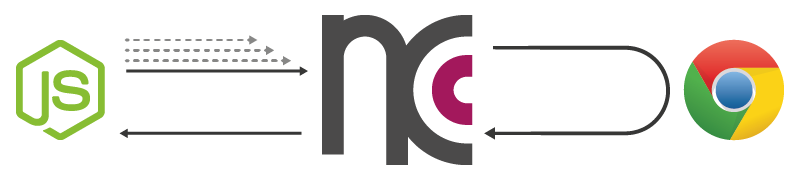
Behind the curtains of the familiar Canvas-API, ncc uses a single WebSocket-Connection and some command-bundeling-logic to gain its performance.
$3
``
npm install ncc
`
`javascript
var ncc = require('ncc')
var canvas = ncc();
canvas.width = canvas.height = 256;
var ctx = canvas.getContext('2d');
ctx.fillStyle = "slateGray";
ctx.fillRect(28, 28, 200, 200)(); // function call is intentional!
`
$3
- draw ncc logo
>> learn how to setup ncc and draw shapes to canvas
- early access
>> learn how to start using ncc even before it is fully set up
- get return values
>> learn how to get return values of non-void functions
- gardients/patterns
>> learn how to use gradients and patterns
- images
>> learn how to apply images from urls or the filesystem
- shadow canvas
>> learn how work with more than one canvas
$3
ncc follows the native Web API Interfaces...
HTMLCanvasElement,
HTMLImageElement,
CanvasRenderingContext2D,
CanvasGradient,
CanvasPattern
... as close as possible.
Differences are a result of the asynchronous nature of ncc. All object creations, method calls and property manipulations don't get processed directly, but get serialized and stored until a return value is necessary and a request is therefore unavoidable.
Every 'Object' provided by ncc (and also every return value of a method) is actually a function to trigger a synchronization. You can pass a error-first-callback ( 'function(error, result){...}' ) to such a function to receive the return value of the last action (see examples).
The Canvas- RenderingContext2D, -Gradient and -Pattern Proxys are fully implemented.
The HTML- CanvasElement and -ImageElement Proxys only necessary properties and functions. For example they both implement a 'width' and 'height' attribute but don´t have further DOM functionality.
Methods and properties beyond the native API are marked with a leading underscore and they are hidden from console by default (e.g. 'image._toFile(fileName, <callback>)' to write an image to the filesystem).
#### proxy - creators
* ncc( <options> , <callback> ) >>> [canvas]
ncc( <callback> ) >>> [canvas]
options (with defaults)
`javascript
{ logLevel: 'info', //['log','info','warn','error']
port: 9222,
retry: 9,
retryDelay: 500,
headless: false
}
``
ncc.createCanvas() >>> [canvas] if one is not enough*
* ncc.createImage( <src> , <onloadFn> , <onerrorFn> ) >>> [image]
nccCanvas.getContext( nativeAPI* ) >>> [context2d]
context2d.createLinearGradient( nativeAPI)* ) >>> [linearGradient]
context2d.createRadialGradient( nativeAPI) ) >>> [radialGradient]
context2d.createPattern( nativeAPI) ) >>> [pattern]