novnc-next
v1.0.0
noVNC is a VNC client JavaScript library and application. This fork adds compatibility for environments like Next.js/SSR.
0/weekUpdated 9 months agoMPL-2.0Unpacked: 4.2 MB
Published by Justin Bojarski
npm install novnc-nextnoVNC-next: A noVNC Fork for Next.js/SSR Compatibility
Maintainer: Justin Bojarski (@Bojo-io)
Original Project: noVNC/noVNC
License: MPL-2.0
---
Note: This repository is a fork of the official noVNC library (@novnc/novnc).
Purpose of this fork:
The primary goal of novnc-next is to provide compatibility with modern JavaScript frameworks like Next.js, specifically addressing issues that arise during Server-Side Rendering (SSR) or build-time execution.
Changes Made:
The core modifications involve guarding access to browser-specific global objects (like window, navigator, document) within the library's internal modules (primarily core/util/browser.js and related files). This prevents errors such as window is not defined or navigator is not defined when the code is processed in a non-browser environment.
Usage in Next.js / SSR Environments:
With these changes, you should be able to import and use novnc-next components or classes within your Next.js application without encountering the common SSR-related errors associated with the original library. Ensure that the component using novnc-next is still treated as a client-side component (e.g., using "use client"; in Next.js App Router or dynamic imports if necessary), as the library fundamentally requires a browser environment to function.
Build Process (Required for Use):
This fork requires a build step to generate distributable files. Run the following commands within this directory:
``bash`
npm install
npm run build # (Build script to be added)
(Original README content follows below)
noVNC: HTML VNC client library and application
$3
noVNC is both a HTML VNC client JavaScript library and an application built on
top of that library. noVNC runs well in any modern browser including mobile
browsers (iOS and Android).
This novnc-next fork specifically adapts the library for easier use within modern web frameworks like Next.js.
Many companies, projects and products have integrated noVNC including
OpenStack,
OpenNebula,
LibVNCServer, and
ThinLinc. See
the Projects and companies wiki page
for a more complete list with additional info and links.
$3
- News/help/contact
- Features
- Screenshots
- Browser requirements
- Server requirements
- Quick start (Library Usage)
- Installation from snap package
- Integration and deployment
- Authors/Contributors
$3
The project website is found at novnc.com.
If you are a noVNC developer/integrator/user (or want to be) please join the
noVNC discussion group.
Bugs and feature requests for the original noVNC project can be submitted via
its github issues. If you have questions
about using noVNC then please first use the
discussion group.
We also have a wiki with lots of
helpful information.
For issues or questions specifically related to this novnc-next fork (e.g., SSR compatibility, build process), please use the issue tracker for this repository.
If you are looking for a place to start contributing to noVNC, a good place to
start would be the issues that are marked as
"patchwelcome".
Please check our
contribution guide though.
If you want to show appreciation for noVNC you could donate to a great non-
profits such as:
Compassion International,
SIL,
Habitat for Humanity,
Electronic Frontier Foundation,
Against Malaria Foundation,
Nothing But Nets, etc.
$3
* Supports all modern browsers including mobile (iOS, Android)
* Supported authentication methods: none, classical VNC, RealVNC's
RSA-AES, Tight, VeNCrypt Plain, XVP, Apple's Diffie-Hellman,
UltraVNC's MSLogonII
* Supported VNC encodings: raw, copyrect, rre, hextile, tight, tightPNG,
ZRLE, JPEG, Zlib, H.264
* Supports scaling, clipping and resizing the desktop
* Supports back & forward mouse buttons
* Local cursor rendering
* Clipboard copy/paste with full Unicode support
* Translations
* Touch gestures for emulating common mouse actions
* Licensed mainly under the MPL 2.0, see
the license document for details
$3
Running in Firefox before and after connecting:
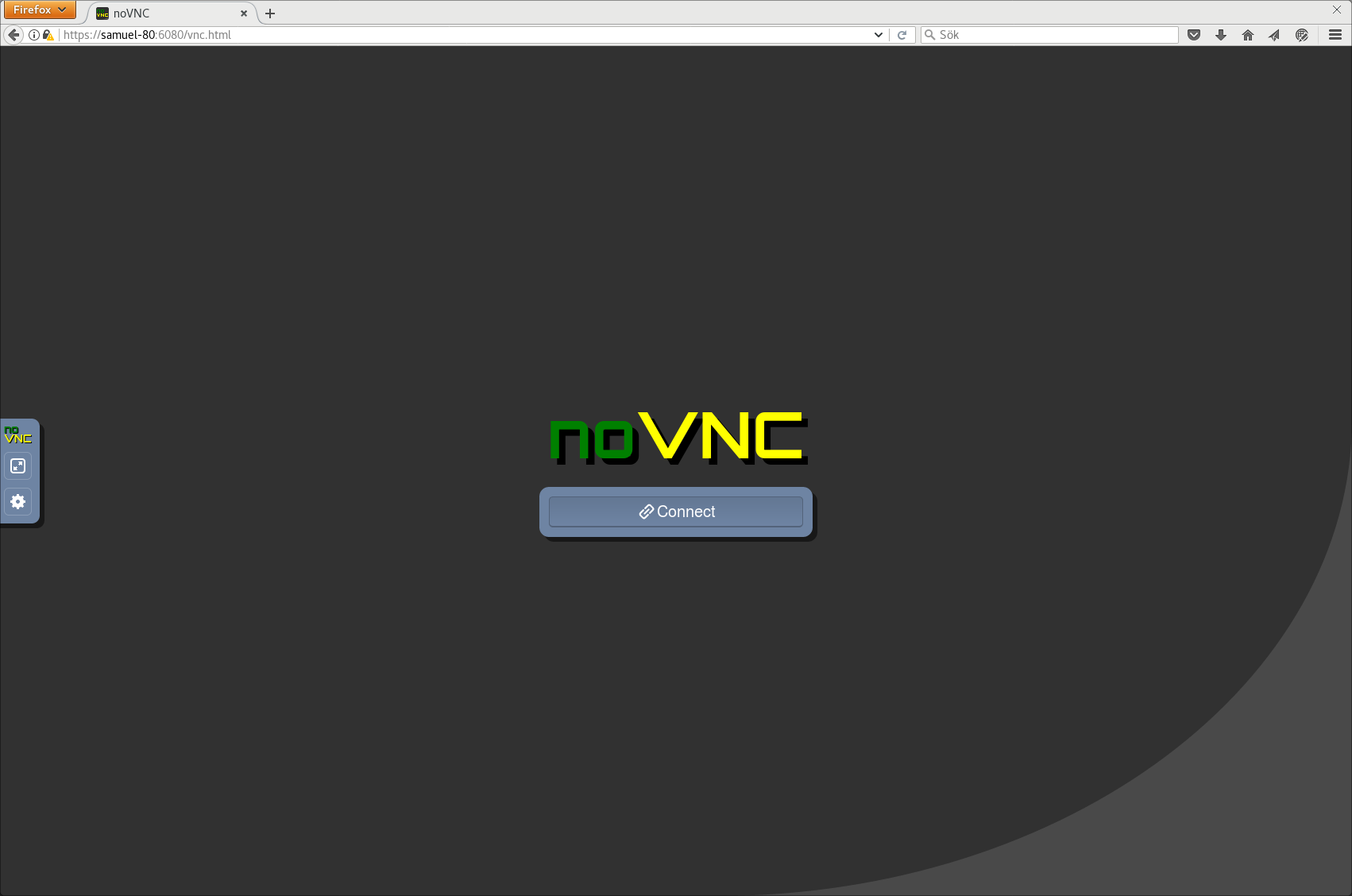
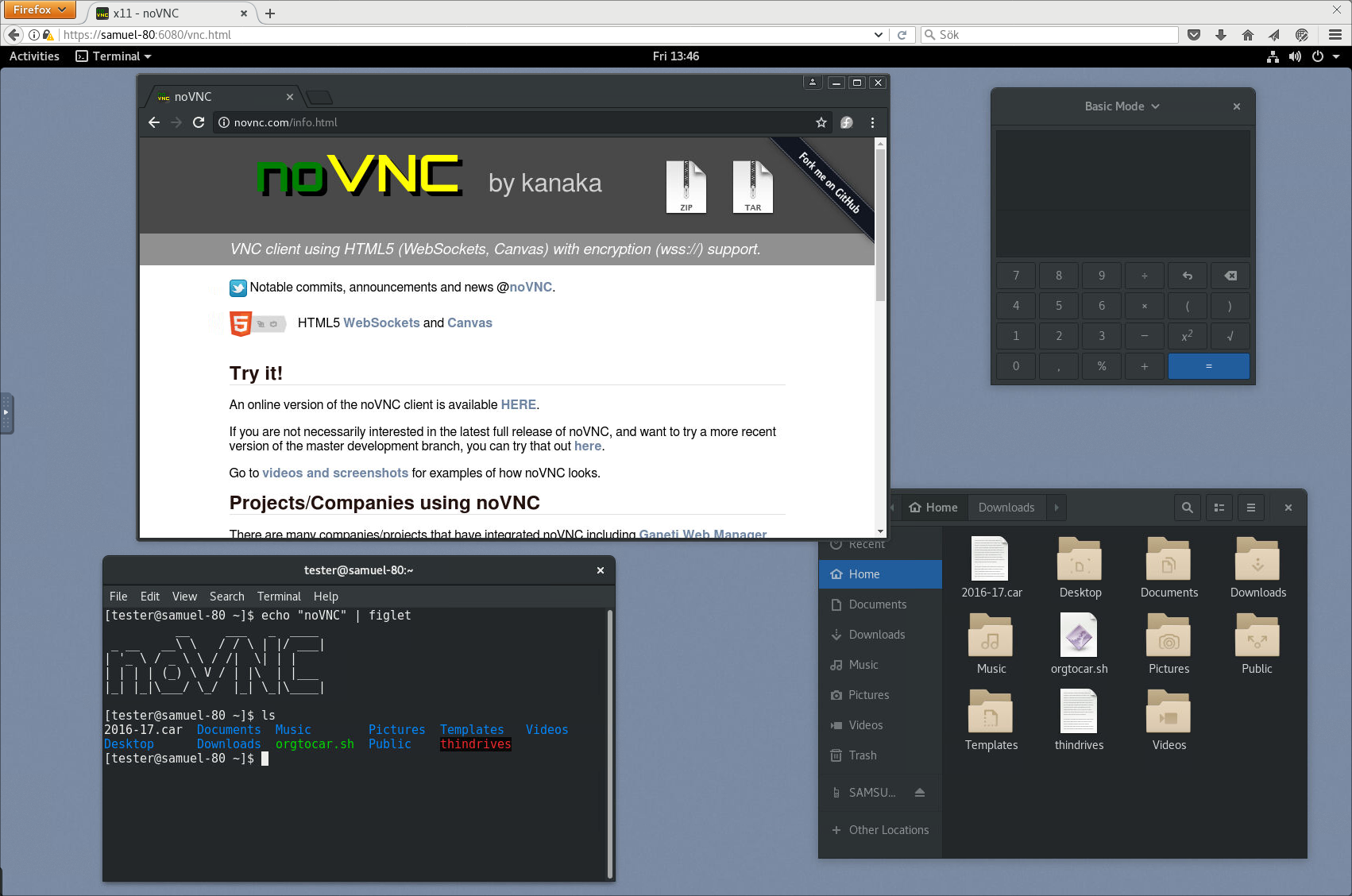
See more screenshots
here.
$3
noVNC uses many modern web technologies so a formal requirement list is
not available. However these are the minimum versions we are currently
aware of:
* Chrome 89, Firefox 89, Safari 15, Opera 75, Edge 89
$3
noVNC follows the standard VNC protocol, but unlike other VNC clients it does
require WebSockets support. Many servers include support (e.g.
x11vnc/libvncserver,
QEMU, and
MobileVNC), but for others you need to
use a WebSockets to TCP socket proxy. noVNC has a sister project
websockify that provides a simple such
proxy.
$3
1. Install the package:
`bash`
# Assuming published to npm:
npm install novnc-next
# For local development (linking):
# In this repo's directory:
npm link
# In your consuming project's directory:
npm link novnc-next
2. Import and use the class:
`javascript
import RFB from 'novnc-next';
// Example usage within a client-side component or script
// Ensure this code runs only in the browser
let rfb;
const targetElement = document.getElementById('vnc-canvas'); // Your target canvas element
const websocketUrl = 'ws://your-vnc-websocket-proxy:6080/';
try {
rfb = new RFB(targetElement, websocketUrl, {
// RFB options (e.g., credentials, shared)
credentials: { password: 'your-vnc-password' },
});
// Add event listeners as needed
rfb.addEventListener('connect', () => {
console.log('VNC connected');
});
rfb.addEventListener('disconnect', (detail) => {
console.log('VNC disconnected:', detail);
});
rfb.addEventListener('credentialsrequired', () => {
const password = prompt("Password Required:");
rfb.sendCredentials({ password: password });
});
// Connect using rfb.connect() if not done automatically
// Manage rfb instance lifecycle (e.g., rfb.disconnect() on component unmount)
} catch (exc) {
console.error('Unable to create RFB client', exc);
}
`
See the Library Usage Guide for more detailed API information.
3. (Optional) Testing with included viewer:
You can still use the included vnc.html page for quick testing. First, start a VNC server and the websockify proxy:`
bash`
# Example: Start websockify proxy for a VNC server running on localhost:5900
websockify 6080 localhost:5900
Then, serve the directory using any simple web server and open vnc.html in your browser.
$3
Running the command below will install the latest release of noVNC from snap:
sudo snap install novnc
#### Running noVNC from snap directly
You can run the snap package installed novnc directly with, for example:
novnc --listen 6081 --vnc localhost:5901 # /snap/bin/novnc if /snap/bin is not in your PATH
If you want to use certificate files, due to standard snap confinement restrictions you need to have them in the /home/\
novnc --listen 8443 --cert ~jsmith/snap/novnc/current/self.crt --key ~jsmith/snap/novnc/current/self.key --vnc ubuntu.example.com:5901
#### Running noVNC from snap as a service (daemon)
The snap package also has the capability to run a 'novnc' service which can be
configured to listen on multiple ports connecting to multiple VNC servers
(effectively a service running multiple instances of novnc).
Instructions (with example values):
List current services (out-of-box this will be blank):
`
sudo snap get novnc services
Key             Value
services.n6080  {...}
services.n6081  {...}
Create a new service that listens on port 6082 and connects to the VNC server
running on port 5902 on localhost:
sudo snap set novnc services.n6082.listen=6082 services.n6082.vnc=localhost:5902
(Any services you define with 'snap set' will be automatically started)
Note that the name of the service, 'n6082' in this example, can be anything
as long as it doesn't start with a number or contain spaces/special characters.
View the configuration of the service just created:
`
sudo snap get novnc services.n6082
Key                    Value
services.n6082.listen  6082
services.n6082.vnc     localhost:5902
Disable a service (note that because of a limitation in snap it's currently not
possible to unset config variables, setting them to blank values is the way
to disable a service):
sudo snap set novnc services.n6082.listen='' services.n6082.vnc=''
(Any services you set to blank with 'snap set' like this will be automatically stopped)
Verify that the service is disabled (blank values):
`
sudo snap get novnc services.n6082
Key                    Value
services.n6082.listen
services.n6082.vnc
$3
Please see our other documents for how to integrate noVNC in your own software,
or deploying the noVNC application in production environments:
* Embedding - For the noVNC application
* Library - For the noVNC JavaScript library
$3
See AUTHORS for a (full-ish) list of authors. If you're not on
that list and you think you should be, feel free to send a PR to fix that.
* novnc-next / @novnc/novnc fork team:
* Justin Bojarski
* @novnc/novnc core team:
* Samuel Mannehed (Cendio)
* Pierre Ossman (Cendio)
* Previous @novnc/novnc core contributors:
* Joel Martin (Project founder)
* Solly Ross (Red Hat / OpenStack)
* Notable @novnc/novnc contributions:
* UI and icons : Pierre Ossman, Chris Gordon
* Original logo : Michael Sersen
* tight encoding : Michael Tinglof (Mercuri.ca)
* RealVNC RSA AES authentication : USTC Vlab Team
* Included libraries:
* base64 : Martijn Pieters (Digital Creations 2), Samuel Sieb (sieb.net)
* DES : Dave Zimmerman (Widget Workshop), Jef Poskanzer (ACME Labs)
* Pako : Vitaly Puzrin (https://github.com/nodeca/pako)
Do you want to be on this list? Check out our
contribution guide and
start hacking!