react-loading-skeleton
v3.5.0TypeScript
Make beautiful, animated loading skeletons that automatically adapt to your app.
966.6K/weekUpdated 1 years agoMITUnpacked: 26.7 KB
Published by David Tang
npm install react-loading-skeleton
React Loading Skeleton
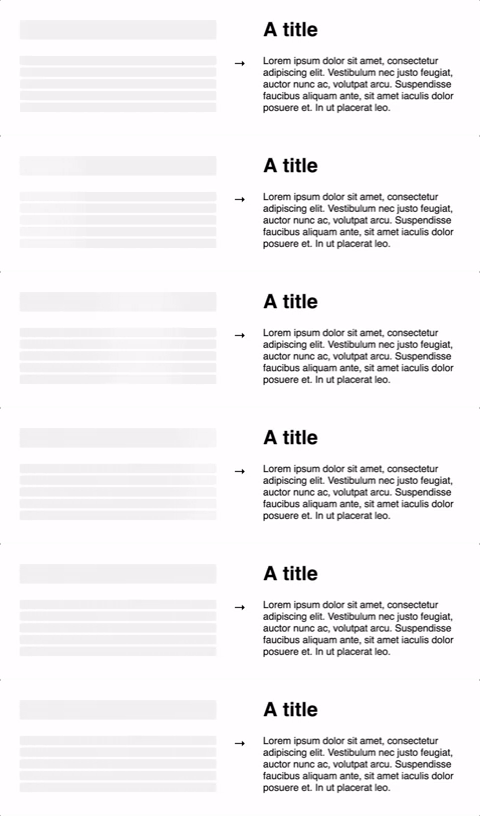
Make beautiful, animated loading skeletons that automatically adapt to your app.
Open on CodeSandbox
Learn about the changes in version
3, or view
the v2
documentation.
Basic Usage
Install via one of:
``bash`
yarn add react-loading-skeleton
npm install react-loading-skeleton
`tsx
import Skeleton from 'react-loading-skeleton'
import 'react-loading-skeleton/dist/skeleton.css'
`
Principles
$3
The Skeleton component should be used directly in your components in place ofSkeleton
content that is loading. While other libraries require you to meticulously craft
a skeleton screen that matches the font size, line height, and margins of your
content, the component is automatically sized to the correct
dimensions.
For example:
`tsx`
function BlogPost(props) {
return (
{props.title ||
{props.body ||
);
}
...will produce correctly-sized skeletons for the heading and body without any
further configuration.
This ensures the loading state remains up-to-date with any changes
to your layout or typography.
$3
Instead, make components with _built-in_ skeleton states.
This approach is beneficial because:
1. It keeps styles in sync.
2. Components should represent all possible states — loading included.
3. It allows for more flexible loading patterns. In the blog post example above,
it's possible to have the title load before the body, while having both
pieces of content show loading skeletons at the right time.
Theming
Customize individual skeletons with props, or render a SkeletonTheme to style
all skeletons below it in the React hierarchy:
`tsx
import Skeleton, { SkeletonTheme } from 'react-loading-skeleton';
return (
);
`
Props Reference
$3
| Prop | Description | Default |
|---|---|---|
count?: number | The number of lines of skeletons to render. If count is a decimal number like 3.5,three full skeletons and one half-width skeleton will be rendered. | 1 |
wrapper?: React.FunctionComponent | A custom wrapper component that goes around the individual skeleton elements. | |
circle?: boolean | Makes the skeleton circular by setting border-radius to50%. | false |
className?: string | A custom class name for the individual skeleton elements which is used alongside the default class, react-loading-skeleton. | |
containerClassName?: string | A custom class name for the <span> that wraps theindividual skeleton elements. | |
containerTestId?: string | A string that is added to the container element as a data-testid attribute. Use it withscreen.getByTestId('...') from React Testing Library. | |
style?: React.CSSProperties | This is an escape hatch for advanced use cases and is not the preferred way to style the skeleton. Props (e.g. width,borderRadius) take priority over this style object. |
$3
| Prop | Description | Default |
|---|---|---|
baseColor?: string | The background color of the skeleton. | #ebebeb |
highlightColor?: string | The highlight color in the skeleton animation. | #f5f5f5 |
width?: string | number | The width of the skeleton. | 100% |
height?: string | number | The height of each skeleton line. | The font size |
borderRadius?: string | number | The border radius of the skeleton. | 0.25rem |
inline?: boolean | By default, a <br /> is inserted after each skeleton sothat each skeleton gets its own line. When inline is true, noline breaks are inserted. | false |
duration?: number | The length of the animation in seconds. | 1.5 |
direction?: 'ltr' | 'rtl' | The direction of the animation, either left-to-right or right-to-left. | 'ltr' |
enableAnimation?: boolean | Whether the animation should play. The skeleton will be a solid color when this is false. You could use this prop to stop the animationif an error occurs. | true |
customHighlightBackground?: string | Allows you to override the background-image property of the highlight element, enabling you to fully customize the gradient. See example below. | undefined |
Examples
$3
There are two ways to wrap a skeleton in a container:
`tsx
function Box({ children }: PropsWithChildren
return (
border: '1px solid #ccc',
display: 'block',
lineHeight: 2,
padding: '1rem',
marginBottom: '0.5rem',
width: 100,
}}
>
{children}
);
}
// Method 1: Use the wrapper prop
const wrapped1 =
// Method 2: Do it "the normal way"
const wrapped2 = (
);
`
$3
You may want to make the gradient used in the highlight element narrower or wider. To do this, you can set the customHighlightBackground prop. Here's an example of a narrow highlight:
`tsx`
If you use this prop, the baseColor and highlightColor props are ignored, but you can still reference their corresponding CSS variables as shown in the above example.
!Custom highlight background example
Troubleshooting
$3
In the example below, the width of the skeleton will be 0:
`tsx`
This happens because the skeleton has no intrinsic width. You can fix it by
applying flex: 1 to the skeleton container via the containerClassName prop.
For example, if you are using Tailwind, your code would look like this:
`tsx`
$3
In the example below, the height of the
 will be slightly larger than 30
even though the
react-loading-skeleton element is exactly 30px.`tsx
`This is a consequence of how
works in CSS. If you need the
to be exactly 30px tall, set its to 1. See
here
for more details.Contributing
Contributions are welcome! See
CONTRIBUTING.md` to get started.Acknowledgements
Our logo is based off an image from Font
Awesome. Thanks!