result-try
v1.0.2TypeScript
A TypeScript Result type and try-catch wrapper utility
0/weekUpdated 1 months agoMITUnpacked: 249.3 KB
Published by Donncha Breen
npm install result-tryresult-try
!npm version
!zero dependencies
!npm bundle size
!license
> Make Failure Predictable
>
> result-try converts implicit exceptions into explicit, strongly-typed values.
Quick Start
``bash`
npm install result-tryor
yarn add result-tryor
pnpm add result-tryor
bun add result-try
`typescript
import { tryResult, ResultError } from "result-try"
// BEFORE: Implicit, unchecked, unsafe
async function unsafeGet() {
try {
const user = await db.users.find(1) // Throws? Retur
return user.name // Crashes if user is null
} catch (error) {
// 'error' is unknown. Cannot access error.message safely
}
}
// AFTER: Explicit, checked, safe
async function safeGet() {
// result: Result
const result = await tryResult(db.users.find(1))
if (!result.ok) {
// Compiler forces you to handle the error path
return console.error(result.error.message)
}
return result.value.name // Type-safe access
}
// Or with destructuring
async function go() {
// user: User | null, error: ResultError | null
const [user, error] = await tryResult(db.users.find(1))
if (error) {
// Compiler forces you to handle the error path
return console.error(error.message)
}
return user.namem // Type-safe access
}
`
The Problem
Even with TypeScript, exceptions are invisible.
1. You don't know if a function throws.
The type signature tells you what it returns, not what breaks it.
2. You don't know what it throws.
Caught errors are typed as unknown, forcing you to write defensive checks just to log a message.
3. You inevitably forget to catch.
And your app crashes in production.
The Solution
result-try forces you to handle exceptions as data, ensuring no error is ever left unhandled.
1. Wraps unstable code (Promises, async functions, sync blocks) safely.
2. Catches every exception and converts it into a Result object.
3. Forces you to handle the failure case before accessing the data.
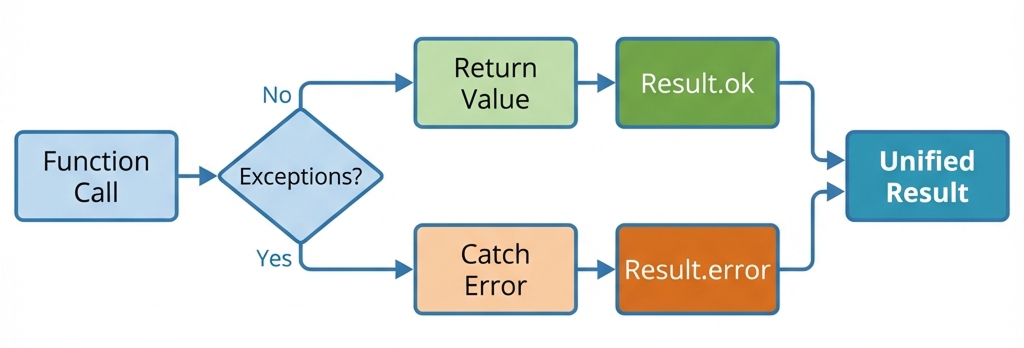
Note: This approach is often called Railway Oriented Programming.
You stay on the "Success Track" until an error switches you to the "Failure Track", but the train never falls off the rails.
Philosophy
- Explicit Control Flow - Make the implicit failure path explicit
- Defensive Consistency - Handle errors at build time, not in production
- Error Normalization & Introspection - Eliminate unknown error ambiguity
- Boundary-First Design - HTTP-friendly errors that travel seamlessly up the call stack
See docs/PHILOSOPHY.md for more details
Usage
$3
Use tryResult for Promises and async functions.
`typescript
import { tryResult, NotFoundError } from "result-try"
const result = await tryResult(fetch("https://api.example.com/data"))
if (result.ok) {
// Standard fetch Response
console.log(result.value.status)
} else {
// Type-safe Error
console.error(result.error.message)
}
// With custom error map
const userResult = await tryResult(
db.findUser(id),
(error) => NotFoundError.from(error)
)
// Destructuring
const [data, error] = await tryResult(fetch("..."))
if (error) {
return handle(error)
}
console.log(data)
`
$3
Use tryResultSync for synchronous operations like JSON parsing.
`typescript
import { tryResultSync, BadRequestError } from "result-try"
const parseResult = tryResultSync(() => JSON.parse(userInput))
// With custom error map
const valResult = tryResultSync(
() => validate(userInput),
(error) => BadRequestError.from(error)
)
// Destructuring
const [data, error] = tryResultSync(() => JSON.parse(userInput))
`
$3
Decorate your class methods to automatically catch errors and return Result types.
Note: Requires "experimentalDecorators": true in your tsconfig.json.
`typescript
import { TryResult, Result, NotFoundError } from "result-try"
class UserService {
// Use default mapping (error -> ResultError.from(error))
@TryResult()
async getUser(id: string) {
const user = await db.find(id)
if (!user) {
return NotFoundError.from("User not found")
}
return Result.ok(user)
}
// Use custom mapping
@TryResult((error) => mapPostgresError(error))
async updateUser(id: string, data: Partial
const user = await db.update(id, data)
return Result.ok(user)
}
}
`
API Reference
$3
A discriminated union that makes it impossible to access value without checking ok.
It also supports array destructuring for a Go-like experience.
`typescript
// Object access
if (result.ok) {
console.log(result.value)
}
// Array destructuring
const [value, error] = result
if (error) {
console.error(error)
}
`
`typescript`
type Result
| { ok: true; value: T }
| { ok: false; error: E }
- Result.ok(value)
- Result.error(error)
- Result.void(): Useful for functions that verify something but return no data.
`typescript
import { Result, ResultError, ForbiddenError } from "result-try"
function validateUser(user: User): Result
if (!user.isActive) {
return Result.error(ForbiddenError.from("User is inactive"))
}
return Result.void()
}
`
Result.unwrap()
Returns the value if ok, otherwise throws the error.
`typescript`
const value = result.unwrap() // Throws if result is error
$3
result-try treats errors as structured data.ResultError
The class ensures every error has a code, status, and message.
We provide standard HTTP-friendly error classes out of the box:
| Error Class | Status | Code |
| :--- | :--- | :--- |
| BadRequestError | 400 | BAD_REQUEST |UnauthorizedError
| | 401 | UNAUTHORIZED |PaymentRequiredError
| | 402 | PAYMENT_REQUIRED |ForbiddenError
| | 403 | FORBIDDEN |NotFoundError
| | 404 | NOT_FOUND |MethodNotAllowedError
| | 405 | METHOD_NOT_ALLOWED |NotAcceptableError
| | 406 | NOT_ACCEPTABLE |TimeoutError
| | 408 | TIMEOUT |ConflictError
| | 409 | CONFLICT |PreconditionFailedError
| | 412 | PRECONDITION_FAILED |PayloadTooLargeError
| | 413 | PAYLOAD_TOO_LARGE |UnsupportedMediaTypeError
| | 415 | UNSUPPORTED_MEDIA_TYPE |UnprocessableEntityError
| | 422 | UNPROCESSABLE_ENTITY |UnprocessableContentError
| | 422 | UNPROCESSABLE_CONTENT |TooManyRequestsError
| | 429 | TOO_MANY_REQUESTS |ClientClosedRequestError
| | 499 | CLIENT_CLOSED_REQUEST |InternalServerError
| | 500 | INTERNAL_SERVER_ERROR |NotImplementedError
| | 501 | NOT_IMPLEMENTED |BadGatewayError
| | 502 | BAD_GATEWAY |ServiceUnavailableError
| | 503 | SERVICE_UNAVAILABLE |GatewayTimeoutError
| | 504 | GATEWAY_TIMEOUT |
You can access these definitions at runtime via HTTP_ERRORS.
$3
All built-in error classes provide two static factory methods for convenient error creation:
from()
Creates an error instance from a message or existing error:
`typescript
import { ResultError, NotFoundError } from "result-try"
// From a string message
const error1 = ResultError.from("User not found")
// From an existing error
try {
await db.findUser(id)
} catch (error) {
const error2 = NotFoundError.from(error)
}
`
result()
Creates an error Result directly (shorthand for Result.error(ErrorClass.from(...))):
`typescript
import { NotFoundError } from "result-try"
// Concise
return NotFoundError.result("User not found")
// Equivalent to
return Result.error(NotFoundError.from("User not found"))
`
$3
A robust stringification utility designed for logging and debugging.
All built-in error classes use inspect internally to ensure that any error caught is preserved safely.
Why use inspect?
- Never crashes: Safe for circular references and deep nesting.
- Rich Types: Serializes Map, Set, BigInt, Error, URL, RegExp and ArrayBuffer.
- Classes: Preserves constructor names for custom classes.
- Errors: Fully serializes Error chains and causes.
`typescript
import { inspect } from "result-try"
// 1. Circular References (No crash)
const circular: any = { self: null }
circular.self = circular
console.log(inspect(circular))
// Output: [Referential Structure]:{"self":null}
// 2. Built-in Types (JSON.stringify usually swallows these)
console.log(inspect(new Map([['key', 'value']]))) // [Map]:[["key","value"]]
console.log(inspect(new Set([1, 2, 3]))) // [Set]:[1,2,3]
console.log(inspect(BigInt(123))) // 123
// 3. Errors
const err = new Error("Boom")
console.log(inspect(err))
// Output: [Error]:{"name":"Error","message":"Boom",...}
// 4. Custom Classes
class User {
constructor(public id: number) {}
}
console.log(inspect(new User(1)))
// Output: [User]:{"id":1}
`
$3
Safe utilities for checking and finding errors.
`typescript
import {
isResultError,
isResultErrorCode,
isResultErrorStatus,
findHTTPErrorFromCode,
getHTTPErrorMessageFromCode
} from "result-try"
// Type Guard
if (isResultError(someValue)) {
console.log(someValue.code) // Safe access
}
// Check Specific Errors (Safe even if value is unknown)
const error: unknown = result.error
if (isResultErrorCode(result.error, "NOT_FOUND")) {
// Handle specific code
}
if (isResultErrorStatus(result.error, 404)) {
// Handle specific status
}
// Find Error Definition by Code
const httpError = findHTTPErrorFromCode("NOT_FOUND")
if (httpError) {
console.log(httpError.message) // "The requested resource could not be found."
}
// Get Error Message from Code
const msg = getHTTPErrorMessageFromCode("BAD_REQUEST", "Fallback message")
``
Publishing Guide
See docs/PUBLISHING.md for instructions on how to publish this package to npm.
License
MIT