tscanner
v0.1.3TypeScript
Code quality scanner for the AI-generated code era
0/weekUpdated 1 months agoMITUnpacked: 159.9 KB
Published by lucasvtiradentes
npm install tscanner
TScanner - CLI
Overview • Features • Motivation • Workflow • Quick Start • Usage
Configuration • Rules • Registry • Inspirations • Contributing • License

🎺 Overview
Define what "good code" means for your project. Scan your codebase from the terminal. Run before commits, in CI pipelines, or as part of your build. 38 ready-to-use rules + custom rules via regex, scripts, or AI.
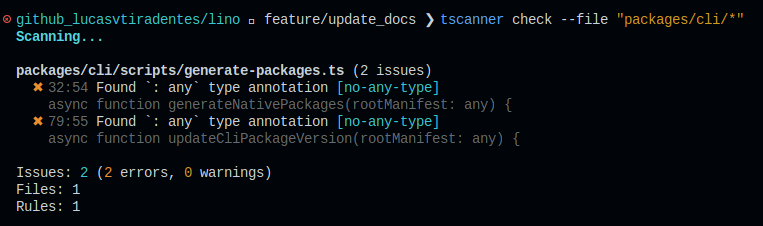
scanning the codebase via CLI
Other ways to use TScanner
| Package | Description |
|---|---|
| Live code issues in sidebar with multiple scan modes and AI clipboard export to fix them | |
| CICD integration with analysis summary attached to PR comments |



⭐ Features
- Your Rules, Enforced - 38 built-in checks + define your own with regex, scripts, or AI
- Community Rules - Install pre-built rules from registry or share your own with the world
- Multiple Scan Modes - Whole codebase, branch changes, uncommitted changes, or staged changes
- Sub-second Scans - Rust engine processes hundreds of files in <1s, with smart caching
- Not a Blocker - Issues are warnings by default; set as errors to fail CI/lint-staged
❓ Motivation
AI generates code fast, but it doesn't know your project's conventions, preferred patterns, or forbidden shortcuts. You end up reviewing the same issues over and over.
TScanner lets you define those rules once. Every AI-generated file, every PR, every save: automatically checked against your standards.
🔀 Workflow
> Vision: Go fast with AI and know exactly what to fix before shipping. Detect bad patterns while reviewing code? Ask AI to create regex, script, or AI rules to catch it forever. Use the VSCode extension's "Copy Issues" button to get a ready-to-paste prompt and let your favorite AI tool fix everything. Before merging, see all issues at a glance in a PR comment from your CI/CD: nothing blocks by default, you decide what matters.
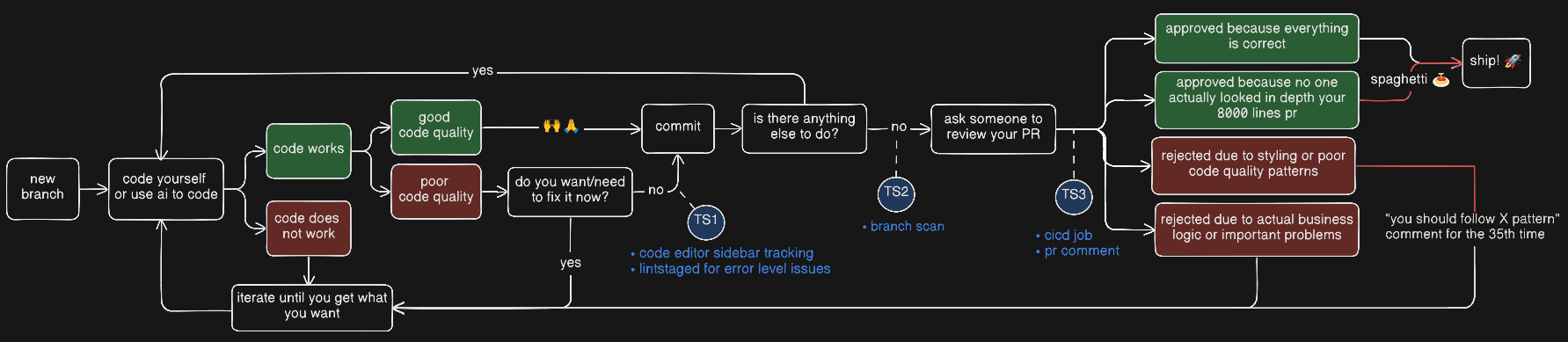
How TScanner fits into the average coding workflow
- Code Editor: See issues in real-time while coding. Add to lint-staged to prevent committing errors.How does TScanner prevent issues from reaching production?
- Before PR: Check all issues in your branch compared to origin/main and fix them before opening a PR.
- CI/CD: Every push to a PR is checked automatically. Get a single comment with clickable links to the exact lines.
- Go fast with confidence: Know exactly what issues to fix before committing or merging.Why does this matter?
- Zero rejected PRs: Over time, eliminate PR rejections due to styling or poor code quality patterns.
- AI-powered quality: Use AI rules to detect patterns that traditional linters miss, and let AI help fix AI-generated code.
- Your job: Observe code patterns to enforce/avoid and add TScanner rules for that.
We use TScanner to maintain this very codebase. Here's our setup: Built-in rules (34 enabled): Standard code quality checks like Regex rules (3): Script rules (8): AI rules (2): > TIP: Check the How TScanner maintains its own codebase?
no-explicit-any, prefer-const, no-console, etc.
- no-rust-deprecated: Block #[allow(deprecated)] in Rust code
- no-rust-dead-code: Block #[allow(dead_code)] - remove unused code instead
- no-process-env: Prevent direct process.env access
- types-parity-match: Ensure TypeScript and Rust shared types are in sync
- config-schema-match: Keep Rust config and TypeScript schema aligned
- cli-builder-match: CLI builder must cover all CLI check flags
- action-zod-match: GitHub Action inputs must match Zod validation
- readme-toc-match: README table of contents must match all headings
- rust-entry-simple: lib.rs and mod.rs should only contain module declarations
- no-long-files: Files cannot exceed 300 lines
- no-default-node-imports: Use named imports for Node.js modules
- no-dead-code: Detect dead code patterns in Rust executors
- find-enum-candidates: Find type unions that could be enums.tscanner/ folder to see the full config and script implementations.
How am I using this to improve my code at work?
I basically observe code patterns to enforce/avoid and add custom rules, here are my current rules:
regex rules:
``jsonc`
"regex": {
"no-nestjs-logger": {
"pattern": "import\\s\\{[^}]Logger[^}]\\}\\sfrom\\s*['\"]@nestjs/common['\"]",
"message": "Do not use NestJS Logger. Import from custom logger instead"
},
"no-typeorm-for-feature": {
"pattern": "TypeOrmModule\\.forFeature\\(",
"message": "Use api/src/way-type-orm.module.ts instead"
},
"avoid-typeorm-raw-queries": {
"pattern": "await this\\.([^.]+)\\.manager\\.query\\(",
"message": "Avoid using RawQueryBuilder. Use the repository instead",
"severity": "error"
},
"no-static-zod-schema": {
"pattern": "static\\s+zodSchema\\s*=",
"message": "Remove 'static zodSchema' from class. The schema is already passed to createZodDto() and this property is redundant"
}
}
script rules:
`jsonc`
"script": {
"entity-registered-in-typeorm-module": {
"command": "npx tsx script-rules/entity-registered-in-typeorm-module.ts",
"message": "Entity must be registered in way-type-orm.module.ts",
"severity": "error",
"include": ["api/src/*/.entity.ts", "api/src/way-type-orm.module.ts"]
},
"entity-registered-in-setup-nest": {
"command": "npx tsx script-rules/entity-registered-in-setup-nest.ts",
"message": "Entity must be registered in setup-nest.ts for tests",
"severity": "error",
"include": ["api/src/*/.entity.ts", "api/test/helpers/setup-nest.ts"]
},
"no-long-files": {
"command": "npx tsx script-rules/no-long-files.ts",
"message": "File exceeds 600 lines limit",
"include": ["*/.ts"]
}
}
ai rules:
`
soon!
Note: my rules at work are not commited to the codebase, so I basically installed tscanner globally and move the .tscanner folder into the .gitignore file
🚀 Quick Start
1. Install locally
`bash`
npm install -D tscanner
2. Initialize configuration
`bash`
npx tscanner init
> TIP: Use npx tscanner init --full for a complete config with example regex, script, and AI rules.
After that you can already use the CLI:
3. Check via terminal
`bashScan workspace
npx tscanner check
Scan uncommitted changes (staged + unstaged)
npx tscanner check --uncommitted
Scan only changed files vs branch
npx tscanner check --branch origin/main
`
4. Integrate with lint-staged (optional)
jsonc
// .lintstagedrc.json
{
  "*": ["npx tscanner check --staged"]
}
`
📖 Usage
Command
Description
Flag
Default
Flag description
check [options] [paths]
Scan code for issues and display results
Scan Mode
--branch <BRANCH>
-
Only show issues in files changed compared to branch (e.g., origin/main)
--staged
-
Scan only git staged files
--uncommitted
-
Scan all uncommitted changes (staged + unstaged)
AI Rules
--include-ai
-
Include AI rules in the scan (slower)
--only-ai
-
Run only AI rules, skip all other rules
Filtering
--glob <GLOB_PATTERN>
-
Filter results by glob pattern (e.g., 'src/*/.ts')
--kind [builtin/regex/script/ai]
-
Filter results by rule type (e.g., 'builtin')
--rule <RULE_NAME>
-
Filter results to specific rule (e.g., 'no-console')
--severity [error/warning/info/hint]
-
Filter results by minimum severity (e.g., 'error')
Output
--format [text/json]
text
Output format: text or json
--group-by [file/rule]
-
Group issues by file or rule
--json-output <FILE>
-
Additionally save JSON output to file (works with any format)
Other
--config-path <CONFIG_DIR>
-
Path to config folder (defaults to .tscanner)
--continue-on-error
-
Continue execution even when errors are found
--no-cache
-
Skip cache and force full scan
init [options]
Create a default configuration file
--full
-
Initialize with all built-in rules, example regex/script/AI rules, and sample files
lsp
Start the LSP server (Language Server Protocol)
-
-
-
registry [options] [name]
Install rules from the TScanner registry
--category <CATEGORY>
-
Filter by category
--config-path <CONFIG_DIR>
-
Path to config folder (defaults to .tscanner)
--force
-
Overwrite existing rules
--kind [ai/script/regex]
-
Filter by rule kind (ai, script, regex)
--latest
-
Use latest rules from main branch instead of version-matched
validate [config-path]
Validate configuration file
-
-
-
⚙️ Configuration
To scan your code, you need to set up the rules in the TScanner config folder.
Full configuration
`json
{
"$schema": "https://unpkg.com/tscanner@latest/schema.json",
"rules": {
"builtin": {
"consistent-return": {},
"max-function-length": {},
"max-params": {},
"no-absolute-imports": {},
"no-alias-imports": {},
"no-async-without-await": {},
"no-console": {},
"no-constant-condition": {},
"no-default-export": {},
"no-duplicate-imports": {},
"no-dynamic-import": {},
"no-else-return": {},
"no-empty-class": {},
"no-empty-function": {},
"no-empty-interface": {},
"no-explicit-any": {},
"no-floating-promises": {},
"no-forwarded-exports": {},
"no-implicit-any": {},
"no-inferrable-types": {},
"no-nested-require": {},
"no-nested-ternary": {},
"no-non-null-assertion": {},
"no-relative-imports": {},
"no-return-await": {},
"no-shadow": {},
"no-single-or-array-union": {},
"no-todo-comments": {},
"no-unnecessary-type-assertion": {},
"no-unreachable-code": {},
"no-unused-vars": {},
"no-useless-catch": {},
"no-var": {},
"prefer-const": {},
"prefer-interface-over-type": {},
"prefer-nullish-coalescing": {},
"prefer-optional-chain": {},
"prefer-type-over-interface": {}
},
"regex": {
"example-no-console-log": {
"pattern": "console\\.log",
"message": "Remove console.log before committing"
}
},
"script": {
"example-no-long-files": {
"command": "npx tsx script-rules/example-no-long-files.ts",
"message": "File exceeds 300 lines limit",
"include": ["packages//.ts", "packages//.rs"]
}
}
},
"aiRules": {
"example-find-enum-candidates": {
"prompt": "example-find-enum-candidates.md",
"mode": "agentic",
"message": "Type union could be replaced with an enum for better type safety",
"severity": "warning",
"include": ["*/.ts"]
}
},
"ai": {
"provider": "claude"
},
"files": {
"include": ["/.ts", "/.tsx", "/.js", "/.jsx", "/.mjs", "/.cjs"],
"exclude": ["/node_modules/", "/dist/", "/build/", "/.git/"]
},
"codeEditor": {
"highlightErrors": true,
"highlightWarnings": true,
"highlightInfos": true,
"highlightHints": true,
"autoScanInterval": 0,
"autoAiScanInterval": 0,
"startupScan": "cached",
"startupAiScan": "off"
}
}
`
Minimal configuration
`json
{
"$schema": "https://unpkg.com/tscanner@latest/schema.json",
"rules": {
"builtin": {
"no-explicit-any": {}
},
"regex": {},
"script": {}
},
"aiRules": {},
"files": {
"include": ["/.ts", "/.tsx", "/.js", "/.jsx", "/.mjs", "/.cjs"],
"exclude": ["/node_modules/", "/dist/", "/build/", "/.git/"]
}
}
`
Additional info
Per-rule file patterns: Each rule can have its own include/exclude patterns:
`json
{
"rules": {
"builtin": {
"no-console": { "exclude": ["src/logger.ts"] },
"max-function-length": { "include": ["src/core/*/.ts"] }
}
}
}
`
Inline disables:
`typescript
// tscanner-ignore-next-line no-explicit-any
const data: any = fetchData();
// tscanner-ignore
// Entire file is skipped
`
📋 Rules
Rules are the core of TScanner. They define what to check, where to check, and how to report issues. Mix built-in rules with custom ones to enforce your team's standards.
Type
Use Case
Example
Built-in
Common typescript anti-patterns
no-explicit-any, prefer-const, no-console
Regex
Simple text patterns for any file
Match TODO comments, banned imports
Script
Complex logic in any language (TS, Python, Rust, Go...)
Enforce folder structure, type parity checks, enforce min/max lines per file
AI
LLM-powered analysis for context-aware patterns (dead code, enum candidates, architectural violations)
Detect potential enum candidates, check if a complex pattern was followed across multiple files
Built-in rules (38)
#### Type Safety (6)
Rule
Description
Options
Also in
Detects usage of TypeScript 'any' type (: any and as any). Using 'any' defeats the purpose of TypeScript's type system.


Detects function parameters without type annotations that implicitly have 'any' type.
Disallows explicit type annotations on variables initialized with literal values. TypeScript can infer these types automatically.
Disallows the non-null assertion operator (!). Use proper null checks or optional chaining instead.
Disallows union types that combine a type with its array form (e.g., string | string[], number | number[]). Prefer using a consistent type to avoid handling multiple cases in function implementations.
Disallows type assertions on values that are already of the asserted type (e.g., "hello" as string, 123 as number).
#### Code Quality (13)
Rule
Description
Options
Also in
Enforces a maximum number of statements in functions. Long functions are harder to understand and maintain.
maxLength: 50
Limits the number of parameters in a function. Functions with many parameters should use an options object instead.
maxParams: 4
Disallows async functions that don't use await. The async keyword is unnecessary if await is never used.
Disallow the use of console methods. Console statements should be removed before committing to production.
methods: [21 items]
Disallows else blocks after return statements. The else is unnecessary since the function already returned.
Disallows empty classes without methods or properties.
Disallows empty functions and methods. Empty functions are often leftovers from incomplete code.
Disallows empty interface declarations. Empty interfaces are equivalent to {} and usually indicate incomplete code.
Disallows nested ternary expressions. Nested ternaries are hard to read and should be replaced with if-else statements.
Disallows redundant 'return await' in async functions. The await is unnecessary since the function already returns a Promise.
Detects TODO comments (case insensitive). Configure 'keywords' option to detect additional markers like FIXME, HACK, etc.
keywords: [1 items]
Detects variables that are declared but never used in the code.
Disallows catch blocks that only rethrow the caught error. Remove the try-catch or add meaningful error handling.
#### Bug Prevention (4)
Rule
Description
Options
Also in
Requires consistent return behavior in functions. Either all code paths return a value or none do.
Disallows constant expressions in conditions (if/while/for/ternary). Likely a programming error.
Disallows floating promises (promises used as statements without await, .then(), or .catch()). Unhandled promises can lead to silent failures.
Detects code after return, throw, break, or continue statements. This code will never execute.
#### Variables (3)
Rule
Description
Options
Also in
Disallows variable declarations that shadow variables in outer scopes. Shadowing can lead to confusing code and subtle bugs.
Disallows the use of 'var' keyword. Use 'let' or 'const' instead for block-scoped variables.
Suggests using 'const' instead of 'let' when variables are never reassigned.
#### Imports (8)
Rule
Description
Options
Also in
Disallows absolute imports without alias. Prefer relative or aliased imports.
Disallows aliased imports (starting with @). Prefer relative imports.
Disallows default exports. Named exports are preferred for better refactoring support and explicit imports.
Disallows multiple import statements from the same module. Merge them into a single import.
Disallows dynamic import() expressions. Dynamic imports make static analysis harder and can impact bundle optimization.
Disallows re-exporting from other modules. This includes direct re-exports (export { X } from 'module'), star re-exports (export * from 'module'), and re-exporting imported values.
Disallows require() calls inside functions, blocks, or conditionals. Require statements should be at the top level for static analysis.
Detects relative imports (starting with './' or '../'). Prefer absolute imports with @ prefix for better maintainability.
#### Style (4)
Rule
Description
Options
Also in
Suggests using 'interface' keyword instead of 'type' for consistency.
Suggests using nullish coalescing (??) instead of logical OR (||) for default values. The || operator treats 0, "", and false as falsy, which may not be intended.
Suggests using optional chaining (?.) instead of logical AND (&&) chains for null checks.
Suggests using 'type' keyword instead of 'interface' for consistency. Type aliases are more flexible and composable.
Regex rules examples
Define patterns to match in your code using regular expressions:
Config (.tscanner/config.jsonc):
`json
{
"rules": {
"regex": {
"no-rust-deprecated": {
"pattern": "allow\\(deprecated\\)",
"message": "No deprecated methods",
"include": ["packages/rust-core/*/.rs"]
},
"no-process-env": {
"pattern": "process\\.env",
"message": "No process env"
},
"no-debug-logs": {
"pattern": "console\\.(log|debug|info)",
"message": "Remove debug statements",
"exclude": ["*/.test.ts"]
}
}
}
}
`
Script rules examples
Run custom scripts in any language (TypeScript, Python, Rust, Go, etc.) that reads JSON from stdin and outputs JSON to stdout.
Input contract (received via stdin):
`json
{
"files": [
{
"path": "src/utils.ts",
"content": "export function add(a: number, b: number)...",
"lines": ["export function add(a: number, b: number)", "..."]
}
],
"options": { "maxLines": 300 },
"workspaceRoot": "/path/to/project"
}
`
Output contract (expected via stdout):
`json
{
"issues": [
{ "file": "src/utils.ts", "line": 10, "message": "Issue description" }
]
}
`
Config (.tscanner/config.jsonc):
`json
{
"rules": {
"script": {
"no-long-files": {
"command": "npx tsx script-rules/no-long-files.ts",
"message": "File exceeds 300 lines limit",
"include": ["/.ts", "/.rs", "/.py", "/.go"]
}
}
}
}
`
TypeScript example
`typescript
#!/usr/bin/env npx tsx
import { stdin } from 'node:process';
async function main() {
let data = '';
for await (const chunk of stdin) data += chunk;
const input = JSON.parse(data);
const issues = [];
for (const file of input.files) {
if (file.lines.length > 300) {
issues.push({ file: file.path, line: 301, message: File exceeds 300 lines });
}
}
console.log(JSON.stringify({ issues }));
}
main().catch((err) => {
console.error(err);
process.exit(1);
});
`
Python example
`python
#!/usr/bin/env python3
import json, sys
def main():
input_data = json.loads(sys.stdin.read())
issues = []
for file in input_data["files"]:
if len(file["lines"]) > 300:
issues.append({"file": file["path"], "line": 301, "message": "File exceeds 300 lines"})
print(json.dumps({"issues": issues}))
if __name__ == "__main__":
main()
`
Rust example
`rust
#!/usr/bin/env rust-script
use std::io::{self, Read};
use serde::{Deserialize, Serialize};
#[derive(Deserialize)]
struct ScriptFile { path: String, lines: Vec }
#[derive(Deserialize)]
struct ScriptInput { files: Vec }
#[derive(Serialize)]
struct ScriptIssue { file: String, line: usize, message: String }
#[derive(Serialize)]
struct ScriptOutput { issues: Vec }
fn main() -> io::Result<()> {
let mut data = String::new();
io::stdin().read_to_string(&mut data)?;
let input: ScriptInput = serde_json::from_str(&data).unwrap();
let mut issues = Vec::new();
for file in input.files {
if file.lines.len() > 300 {
issues.push(ScriptIssue { file: file.path, line: 301, message: "File exceeds 300 lines".into() });
}
}
println!("{}", serde_json::to_string(&ScriptOutput { issues }).unwrap());
Ok(())
}
`
> 💡 See real examples in the .tscanner/script-rules/
AI rules examples
Use AI prompts (markdown files) to perform semantic code analysis. Works with any AI provider (Claude, OpenAI, Ollama, etc.).
Modes - How files are passed to the AI:
| Mode | Description | Best for |
|------|-------------|----------|
| paths | Only file paths (AI reads files via tools) | Large codebases, many files |
| content | Full file content in prompt | Small files, quick analysis |
| agentic | Paths + AI can explore freely | Cross-file analysis, complex patterns |
Placeholders - Use in your prompt markdown:
| Placeholder | Replaced with |
|-------------|---------------|
| {{FILES}} | List of files to analyze (required) |
| {{OPTIONS}} | Custom options from config (optional) |
Output contract - AI must return JSON:
`json
{
"issues": [
{ "file": "src/utils.ts", "line": 10, "column": 1, "message": "Description" }
]
}
`
Config (.tscanner/config.jsonc):
`json
{
"aiRules": {
"find-enum-candidates": {
"prompt": "find-enum-candidates.md",
"mode": "agentic",
"message": "Type union could be replaced with an enum",
"severity": "warning",
"include": ["/.ts", "/.tsx", "*/.rs"]
},
"no-dead-code": {
"prompt": "no-dead-code.md",
"mode": "content",
"message": "Dead code detected",
"severity": "error",
"include": ["*/.rs"],
"options": { "allowTestFiles": true }
}
},
"ai": {
"provider": "claude"
}
}
`
Prompt example (agentic mode)
`markdown
Enum Candidates Detector
Find type unions that could be replaced with enums.
What to look for
1. String literal unions: \type Status = 'pending' | 'active'\
2. Repeated string literals across files
3. Type unions used as discriminators
Exploration hints
- Check how the type is used across files
- Look for related constants
---
Files
{{FILES}}
`
Prompt example (with options)
`markdown
Dead Code Detector
Detect dead code patterns.
Rules
1. No \#[allow(dead_code)]\ attributes
2. No unreachable code after return/break
Options
{{OPTIONS}}
Files
{{FILES}}
`
> 💡 See real examples in the .tscanner/ai-rules/
📦 Registry
The registry is a collection of community rules ready to install with a single command.


bash
npx tscanner registry                     # List all available rules (and you chose the ones you want to install)
npx tscanner registry no-long-files       # Install a specific rule
npx tscanner registry --kind script       # Filter by type (ai, script, regex)
npx tscanner registry --category security # Filter by category
npx tscanner registry --latest            # Use rules from main branch instead of current version
`Available rules (5)
Rule
Type
Language
Description
find-enum-candidates


Find string literal unions that could be replaced with enums
no-long-files


Enforce maximum lines per file limit
no-empty-files

Enforce minimum lines per file
no-fixme-comments

Disallow FIXME/XXX comments in code
no-process-env

-
Disallow direct process.env access
> Want to share your rule? Open a PR adding your rule to the
folder. Once merged, everyone can install it with npx tscanner registry your-rule-name`.💡 Inspirations
- Biome - High-performance Rust-based linter and formatter for web projects
- ESLint - Find and fix problems in your JavaScript code
- Vitest - Next generation testing framework powered by Vite
- VSCode Bookmarks - Bookmarks Extension for Visual Studio Code
How each project was used?
- Biome:
- multi-crate Rust architecture (cli, core, server separation)
- LSP server implementation for real-time IDE diagnostics
- parallel file processing with Rayon
- SWC parser integration for JavaScript/TypeScript AST
- visitor pattern for AST node traversal
- file-level result caching strategy
- ESLint:
- inline suppression system (disable-next-line, disable-file patterns)
- precursor on javascript linting concepts
- inspiration for rule ideas and detection patterns
- Vitest:
- glob pattern matching techniques for file discovery
- VSCode Bookmarks:
- sidebar icon badge displaying issue count
Notes about the huge impact Biome has on this project
This project only makes sense be