zenox
v1.5.1TypeScript
OpenCode plugin with specialized agents (explorer, librarian, oracle, ui-planner), background tasks for parallel execution, and smart orchestration
232/weekUpdated 2 days agoMITUnpacked: 870.4 KB
Published by Ayush
npm install zenox
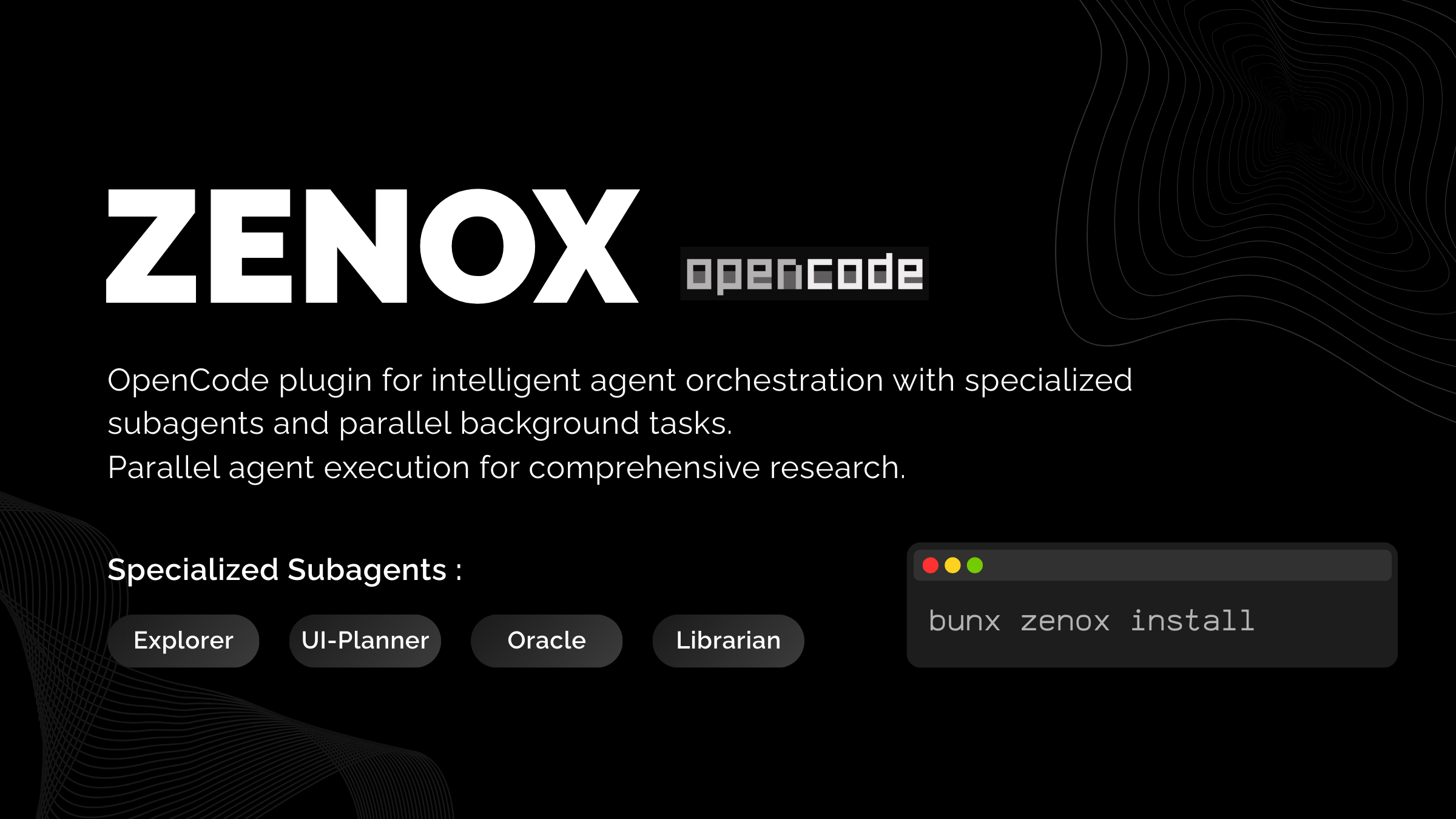
ZENOX
Intelligent agent orchestration for OpenCode


---
Zenox supercharges OpenCode with specialized AI agents that handle different aspects of development. Instead of one agent doing everything, you get a team of experts — each optimized for their domain.
Features
- 4 Specialized Agents — Explorer, Librarian, Oracle, UI Planner
- Background Tasks — Fire multiple agents in parallel
- Thinking Mode Variants — Configure thinking levels (high, xhigh, max) per agent
- Keyword Triggers — ultrawork, deep research, explore codebase
- Session History — Query past sessions to learn from previous work
- Code Intelligence — Search symbols via LSP
- Project Guidelines Auto-Update — Automatically keeps AGENTS.md and CLAUDE.md up-to-date
- Todo Continuation — Auto-reminds when tasks are incomplete
- Auto-Updates — Toast notification when new version available
Why Zenox?
Most AI coding assistants use a single model for everything. Zenox takes a different approach:
- Explorer finds code fast — optimized for codebase search with a lightweight model
- Librarian digs deep into docs — researches libraries, finds GitHub examples, citations included
- Oracle thinks strategically — architecture decisions, debugging, technical trade-offs
- UI Planner designs beautifully — CSS, animations, interfaces that don't look AI-generated
The main agent automatically delegates to specialists when needed. You don't have to manage them.
Quick Start
``bash`
bunx zenox install
That's it. Restart OpenCode and the agents are ready.
Agents
| Agent | What it does | Default Model |
|-------|-------------|---------------|
| Explorer | Codebase grep, file discovery, pattern matching | claude-haiku-4-5 |claude-sonnet-4-5
| Librarian | Library research, docs lookup, GitHub examples | |gpt-5.2
| Oracle | Architecture decisions, debugging strategy, code review | |gemini-3-pro-high
| UI Planner | Frontend design, CSS, animations, visual polish | |
$3
You don't need to call agents directly. The main agent (Build/Plan) automatically delegates:
`
You: "Where's the authentication logic?"
→ Explorer searches the codebase
You: "How does React Query handle caching?"
→ Librarian fetches official docs + real examples
You: "Should I use Redux or Zustand here?"
→ Oracle analyzes trade-offs for your codebase
You: "Make this dashboard look better"
→ UI Planner redesigns with proper aesthetics
`
Keyword Triggers
Include these magic words in your prompt to unlock special modes:
| Keyword | What it does |
|---------|--------------|
| ultrawork or ulw | Maximum multi-agent coordination — fires parallel background agents, sets max precision |deep research
| | Comprehensive exploration — fires 3-4 background agents (explorer + librarian) |explore codebase
| | Codebase mapping — multiple explorers search in parallel |
$3
`
You: "ultrawork - add authentication to this app"
→ ⚡ Ultrawork Mode activated
→ Fires explorer + librarian in parallel
→ Maximum precision engaged
You: "deep research how this project handles errors"
→ 🔬 Deep Research Mode activated
→ Fires multiple explorers + librarians
→ Waits for comprehensive results before proceeding
You: "explore codebase for payment logic"
→ 🔍 Explore Mode activated
→ Multiple explorers search patterns, implementations, tests
`
You'll see a toast notification when these modes activate.
Background Tasks
Need comprehensive research? Fire multiple agents in parallel:
`
background_task(agent="explorer", description="Find auth code", prompt="...")
background_task(agent="librarian", description="JWT best practices", prompt="...")
// Both run simultaneously while you keep working
// You're notified when all tasks complete
`
$3
Zenox shows toast notifications for background task events:
- ⚡ Task Launched — Shows task description and agent
- ✅ Task Completed — Shows duration and remaining count
- 🎉 All Complete — Shows summary of all finished tasks
- ❌ Task Failed — Shows error message
Session History
Query past sessions to learn from previous work:
| Tool | What it does |
|------|--------------|
| session_list | List recent sessions to find relevant past work |session_search
| | Search messages across sessions for how something was done |
`
You: "How did we implement auth last time?"
→ session_search({ query: "authentication" })
→ Finds excerpts from past sessions where auth was discussed
Code Intelligence
Search for symbols via LSP (Language Server Protocol):
| Tool | What it does |
|------|--------------|
| find_symbols | Search for functions, classes, variables by name |lsp_status
| | Check which language servers are running |
`
You: "Find where handleLogin is defined"
→ find_symbols({ query: "handleLogin" })
→ Returns: Function in src/auth/handlers.ts, line 42
Todo Continuation
Zenox automatically reminds you to continue working when:
- You have incomplete tasks in your todo list
- The session goes idle
- There's been enough time since the last reminder (10 second cooldown)
This keeps you on track without manual intervention. The agent will be prompted to continue until all todos are complete or blocked.
Project Guidelines Auto-Update
Zenox automatically keeps your AGENTS.md and CLAUDE.md files up-to-date with important decisions, patterns, and conventions.
$3
Developers forget to update documentation. Important decisions get lost. Team members repeat the same questions. Next session, the agent has no context.
$3
Zenox detects important decisions and automatically documents them:
`
You: "In this project, always use Zustand for state management"
→ Agent checks AGENTS.md — not documented yet
→ Agent saves: "- State Management: Use Zustand, not Redux"
→ Future sessions automatically know this
$3
| Trigger | Example |
|---------|---------|
| User decision | "Always use Tailwind", "We use this API pattern" |
| Architecture choice | Agent decides between approaches after analysis |
| Reusable code | Agent creates a utility worth reusing |
| Convention discovered | Agent notices consistent patterns in codebase |
$3
1. Agent recognizes something important
2. Reads AGENTS.md / CLAUDE.md to check if already documentedsave_project_guideline
3. If not there → calls to add itAGENTS.md
4. Both files get updated (or created if neither exists)
Zero manual work — your project documentation stays current automatically.
Configuration
$3
During installation, choose "Customize models" to pick your own. Or run later:
`bash`
bunx zenox config
Config saves to ~/.config/opencode/zenox.json:
`json`
{
"agents": {
"explorer": { "model": "anthropic/claude-sonnet-4.5" },
"oracle": { "model": "openai/gpt-5.2" }
}
}
$3
Configure thinking/reasoning levels for models that support extended thinking (like Claude, GPT with reasoning, etc.):
`json`
{
"agents": {
"oracle": {
"model": "anthropic/claude-opus-4-5",
"variant": "high"
},
"ui-planner": {
"model": "openai/gpt-5.2-codex",
"variant": "xhigh"
}
}
}
Available variants (model-dependent):
- low — Minimal thinkingmedium
- — Balanced thinkinghigh
- — Extended thinkingxhigh
- — Extra high thinkingmax
- — Maximum reasoning depth
Variants are applied safely — if an agent doesn't exist or the model doesn't support the variant, it gracefully falls back.
$3
`json`
{
"disabled_agents": ["ui-planner"],
"disabled_mcps": ["grep_app"]
}
Included MCP Servers
Zenox auto-loads these tools for agents to use:
| Server | Purpose |
|--------|---------|
| exa | Web search, docs lookup, URL crawling |
| grep_app | Search millions of GitHub repos instantly |
| sequential-thinking | Step-by-step reasoning for complex problems |
CLI
`bash`
bunx zenox install # Add to opencode.json + configure models
bunx zenox install --no-tui # Non-interactive (uses defaults)
bunx zenox config # Reconfigure models anytime
bunx zenox --help # Show all commands
Auto-Update
Zenox checks for updates on startup. When a new version drops:
1. You see a toast notification
2. Bun cache is invalidated
3. Restart to get the update
Pin a version to disable: "zenox@1.2.1"` in your plugins array.
Credits
- OpenCode — The CLI this extends
- oh-my-opencode — Inspiration for orchestration patterns